Loading NexProTools...
Preparing interactive calculation engine
Preparing interactive calculation engine
Simplify given ratios to their simplest form, or solve for missing variables to compute equivalent proportions. Our free calculator also handles scaling up or down, and helps solve complex ratio problems instantly.
Deterministic Mathematical Simulation Engine • Client-Side Computation
Simplify given ratios to their simplest form, or solve for missing variables to compute equivalent proportions. Our free calculator also handles scaling up or down, and helps solve complex ratio problems instantly.
| Parameter | Value | Unit |
|---|---|---|
| First Term (A) | 4 | — |
| Second Term (B) | 6 | — |
| Target Term (A) [To Solve B] | 12 | — |
| Metric | Calculated Output |
|---|---|
| Simplified Ratio | 2 : 3 |
| Solved Equivalent (B) | 18 |
Want to use this tool on your own blog or website? Copy the code below to embed a fully interactive responsive version instantly.
This Ratio Calculator tool is provided strictly for educational and illustrative purposes. Calculations are derived using standard geometric and algebraic axioms. While the tool outputs precise solutions based on exact input values, floating-point rounding limits in code may introduce minor decimal deviations. All values should be checked independently for academic or engineering submissions.
A: [████] (4)
B: [██████] (6)

Target proportion:
Target A: [████████████] (12)
Target B: [██████████████████] (18)
Personalized Actionable Insights
Your input ratio has been successfully scaled and simplified. Ratios are fundamental for understanding proportional relationships in data. Proportions are critical for adjusting culinary recipes, architectural blueprints, mapping grid dimensions accurately without distorting spatial relations, and calculating financial metrics. Understanding these relationships allows you to scale systems predictably.
Check division limits: Ensure neither term is zero to avoid undefined mathematical divisions.
Use the simplified base: Rely on the simplified ratio format for cleaner scale adjustments and documentation.
Maintain scale consistency: Apply the solved multiplier uniformly to all other dimensions in your set.
Verify your units: Always ensure both sides of the ratio represent the same unit of measurement (e.g., inches to inches) unless creating a specific rate.
Convert to percentages: For presentations, consider converting your ratio into a percentage for easier audience comprehension.
Check cross-multiplication: Verify equivalent ratios by cross-multiplying; if A × D equals B × C, the proportion is valid.
Understand the logic under the hood. Here is the formula and exact variable mappings utilized by the Ratio Calculator to compile results.
A / B = TargetA / TargetB => TargetB = (TargetA * B) / A
Ratios are simplified by computing their greatest common divisor (GCD) and dividing each term by it. Proportions are solved using cross-multiplication principles to find missing variables in equivalent relationships.
Initial terms of the ratio relationship
The target value to solve the proportion
The solved equivalent missing value
Greatest Common Divisor used for simplification
Our Ratio Calculator executes robust algorithmic code to deliver instant, entertainment-optimized calculations for social sharing and reflex stats.
See the calculation in action. Below is a step-by-step mathematical example using default parameters to demonstrate how values are processed and generated.
Original recipe requires 2 cups flour to 3 cups sugar (2:3)
To double, multiply both terms by 2
New ratio is 4:6
Use 4 cups flour and 6 cups sugar
Map scale is 1:50,000 (1 inch = 50,000 inches)
Distance on map is 3 inches
Set up proportion: 1/50000 = 3/x
Cross multiply: x = 150,000 inches
Target color requires 3 parts yellow to 2 parts blue (3:2)
You have 15 ounces of yellow paint
Set up proportion: 3/2 = 15/x
Cross multiply: 3x = 30, so x = 10 ounces of blue paint needed
Stock price is $120 and Earnings per share is $5
Ratio is 120:5
Simplify by dividing both sides by 5
P/E Ratio is 24:1 (or simply 24)
Simplified ratio is 2:3
Cross multiply: x = (12 * 6) / 4
Solved equivalent value is 18
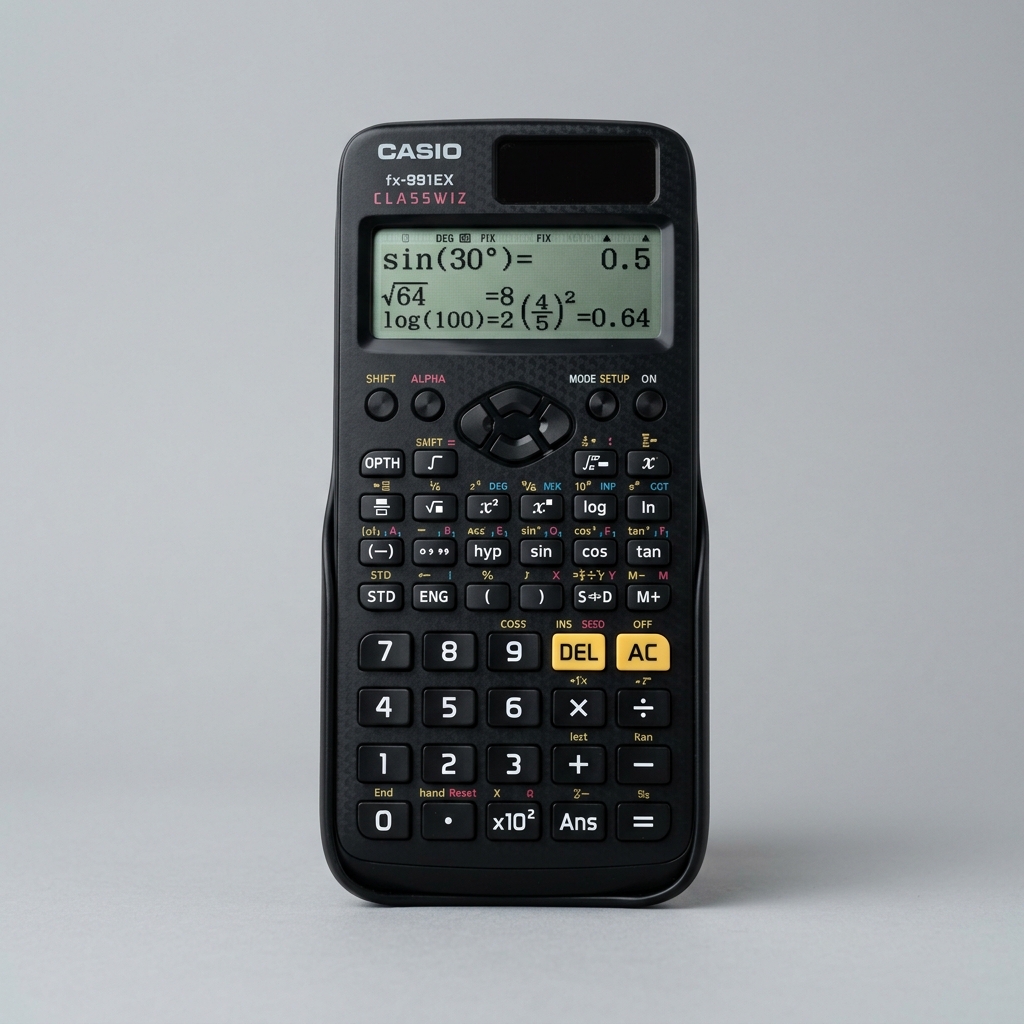
The #1 recommended scientific calculator for board exams, college algebra, mathematics, and engineering classes.
As an Amazon Associate we earn from qualifying purchases.
Perform arithmetic operations on fractions: add, subtract, multiply, and divide two fractions. Simplifies the results dynamically and provides decimal equivalencies.
Convert any positive or negative decimal value into its simplest fraction form, showing both proper/mixed fractions and percentages.
Calculate the percentage change between an initial and a final value, determining whether it represents an increase or decrease.
Did you find these formulas useful? You can bookmark this page (press Ctrl+D) to access it instantly anytime, copy the live URL overrides, or even embed a fully interactive responsive widget on your own blog.
Simplify ratios to lowest terms, solve missing proportions (A:B = C:X), scale dimensions, and convert ratios to fractions or percentages. Free step-by-step ratio solver with worked examples.
Simplify given ratios to their simplest form, or solve for missing variables to compute equivalent proportions. Our free calculator also handles scaling up or down, and helps solve complex ratio problems instantly.
A ratio represents a quantitative comparison between two numbers, specifying how many times one value contains another. Mathematically, a ratio between quantities A and B can be expressed as A:B, A/B, or "A to B". Simplifying a ratio involves finding the Greatest Common Divisor (GCD) of both terms and dividing each term by that common factor. For instance, in the ratio 12:18, the GCD is 6; dividing both terms by 6 yields the irreducible ratio 2:3.
When solving equivalent proportions of the form A / B = C / X (where X is the missing Target B value), we apply the fundamental property of equal ratios: cross-multiplication. Multiplying diagonal terms gives A × X = B × C. Isolating X produces the formula X = (B × C) / A. Understanding whether a ratio describes part-to-part relationships (e.g., 2 parts flour to 3 parts sugar) or part-to-whole relationships (e.g., 2 parts flour out of 5 total parts) is essential when scaling real-world ingredients, financial allocations, or architectural models.
A ratio is a simple comparison between two quantities (such as 3:4 or 3 out of 4). A proportion is an equation stating that two distinct ratios are equal to one another (such as 3:4 = 6:8). Ratios state relationships, while proportions let you solve for missing equivalent values.
To convert a part-to-part ratio (A:B) into a percentage of the total whole, add the terms together to get the total parts (A + B). Then divide part A by the total and multiply by 100: Percentage = [A / (A + B)] × 100. For example, in a 1:4 ratio, total parts equal 5, so 1 / 5 = 0.20 or 20%.
Ratios comparing physical quantities (like lengths, weights, or ingredients) must be positive numbers. Mathematically, the denominator or second term of a ratio (B) cannot be zero, as division by zero is undefined. However, financial metrics (like earnings changes) may occasionally reference negative directional ratios.
A 3-part ratio compares three quantities simultaneously (e.g., A:B:C = 6:12:18). To simplify a 3-part ratio, find the Greatest Common Divisor shared by ALL three terms (GCD of 6, 12, 18 is 6) and divide each number by 6 to yield 1:2:3.
Not quite. While both can be written with division slashes (A/B), a fraction usually represents part of a single whole (e.g., 3/4 of a pizza). A ratio compares two independent quantities to each other (e.g., 3 pepperoni slices for every 4 cheese slices).
Last updated: June 2026. All results are estimates for informational purposes only and do not constitute professional advice.
Learn the math behind ratios and proportions. Master scaling values, dividing amounts by ratios, and solving proportions using cross-multiplication.
Master ratio and proportion calculations with step-by-step formulas, simplification techniques, and practical real-world math applications.
Step-by-step quadratic equation solver with real-time SVG parabola graphing.
Calculate 3D vector dot products, cross products, angles, and 2x2 determinants.
Calculate your semester GPA (Grade Point Average) dynamically based on grades and credit hours for up to 4 courses.
Disclaimer: This Ratio Calculator tool is provided strictly for educational and illustrative purposes. Calculations are derived using standard geometric and algebraic axioms. While the tool outputs precise solutions based on exact input values, floating-point rounding limits in code may introduce minor decimal deviations. All values should be checked independently for academic or engineering submissions. All calculations are performed entirely in your browser — no data is sent to our servers.