In mathematics and daily life, we frequently compare sizes, speeds, prices, and quantities. The most efficient tools for these comparisons are ratios and proportions. A ratio is a mathematical comparison of two or more numbers, while a proportion is an equation stating that two ratios are equal. Understanding this math is essential for everything from cooking recipes to engineering blueprints.
1. What is a Ratio and How is it Written?
A ratio compares the relative sizes of two values. It tells you how much of one thing there is compared to another. For example, if a bag contains 8 red marbles and 4 blue marbles, the ratio of red to blue is 8 to 4. We can write this comparison in three standard ways:
- With a colon (Colon Form): 8:4
- As a fraction (Fraction Form): 8/4
- With words (Word Form): 8 to 4
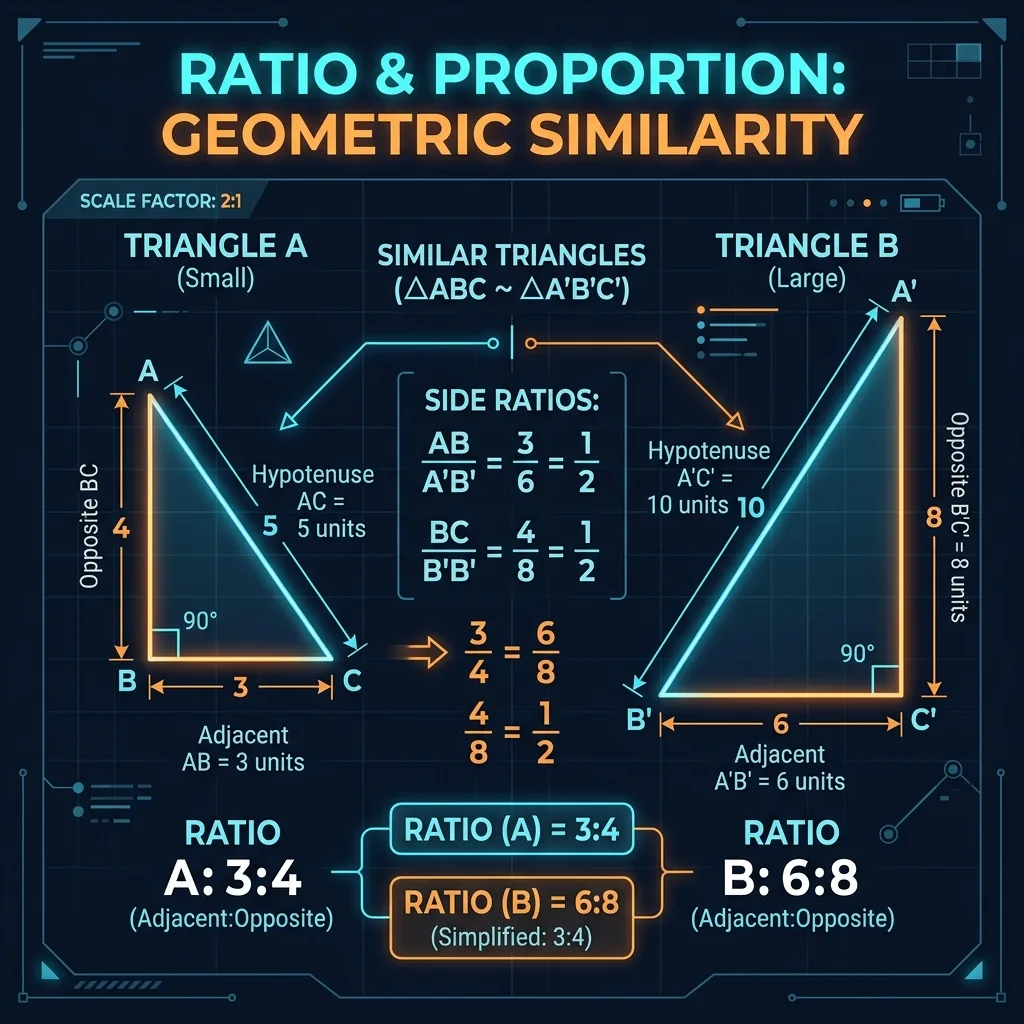
Ratios can represent part-to-part relationships (comparing red marbles to blue marbles) or part-to-whole relationships (comparing red marbles to the total marbles in the bag).
2. How to Simplify a Ratio Step-by-Step
Just like fractions, ratios are easiest to understand in their simplest form. To simplify a ratio, find the Greatest Common Divisor (GCD) of the terms and divide each term by that number. For the ratio 8:4, the GCD of 8 and 4 is 4. Dividing both sides by 4 yields the simplified ratio 2:1.
Simplification Formula: For a ratio a : b, find GCD(a, b). Simplified Ratio = (a / GCD) : (b / GCD)
3. Understanding Proportions: Solving for X
A proportion states that two ratios are equivalent. For example, the ratio 1:2 is proportional to 5:10. When one value in a proportion is unknown, we can use algebra to solve for it (often called solving for X). The most common method to solve proportions is cross-multiplication.
Cross-Multiplication Rule: If a/b = c/d, then a × d = b × c. To solve for an unknown d: d = (b × c) / a
4. Real-World Applications of Ratios and Proportions
Ratios and proportions appear in everyday activities more than you might realize:
- Scaling Recipes: If a recipe for 4 people requires 2 cups of flour, what is the ratio? It is 2:4 (or 1:2). If you need to cook for 10 people, you set up the proportion: 1/2 = X/10. Cross-multiplying gives 2 × X = 10, meaning X = 5 cups of flour.
- Aspect Ratios (Screens & TV): Modern widescreen displays use a 16:9 aspect ratio. If a screen width is 1920 pixels, what is the height? Solve the proportion: 16/9 = 1920/H. Cross-multiplying gives 16 × H = 17280, meaning H = 1080 pixels (Full HD).
- Map Scaling: A map scale of 1:50,000 indicates that 1 centimeter on the map represents 50,000 centimeters (500 meters) in the physical world.
Ready to calculate some ratios? Scroll down to the interactive Ratio & Proportion Calculator below, input your values, and solve for the missing term instantly with step-by-step visual results!