Loading NexProTools...
Preparing interactive calculation engine
Preparing interactive calculation engine
Calculate number of chemical moles (n = m / M) using sample mass in grams and molecular weight (molar mass).
Deterministic Mathematical Simulation Engine • Client-Side Computation
Calculate number of chemical moles (n = m / M) using sample mass in grams and molecular weight (molar mass).
| Parameter | Value | Unit |
|---|---|---|
| Chemical Mass (m) | 250 | g |
| Molar Mass (M) | 58.44 | g/mol |
| Metric | Calculated Output |
|---|---|
| Amount of Moles (n) | 4.278 |
Want to use this tool on your own blog or website? Copy the code below to embed a fully interactive responsive version instantly.
This Stoichiometry Moles Calculator tool is provided strictly for educational and illustrative purposes. Calculations are derived using standard physical equations and chemical stoichiometric ratios. While the tool outputs precise solutions based on exact input values, floating-point rounding limits in code may introduce minor decimal deviations. All values should be checked independently for academic, research, or laboratory submissions.
Personalized Actionable Insights
Your sample contains 4.2779 moles of the substance, calculated using the formula n = m ÷ M. This mole quantity is the fundamental unit for stoichiometric ratio balancing in chemical equations.
Use this mole count in your balanced equation to find the mole ratios of reactants and products.
Convert to particles: Multiply your moles by Avogadro's number (6.022 × 10²³) to count molecules.
Verify your molar mass: Cross-reference the molecular formula using the periodic table for accuracy.
Understand the logic under the hood. Here is the formula and exact variable mappings utilized by the Stoichiometry Moles Calculator to compile results.
STOICHMOLESRESULT = stoichMass / (stoichMolarMass || 1)
The Stoichiometry Moles Calculator processes mathematical rules to calculate instant results. By taking inputs, applying standard parameters, and updating equations, it yields precise values without manual accounting errors.
Adjustable user parameter. Enter a valid value between 0 and unlimited (Default value: 250g).
Adjustable user parameter. Enter a valid value between 0 and unlimited (Default value: 58.44g/mol).
Our Stoichiometry Moles Calculator executes robust algorithmic code to deliver instant, entertainment-optimized calculations for social sharing and reflex stats.
See the calculation in action. Below is a step-by-step mathematical example using default parameters to demonstrate how values are processed and generated.
Initialize all calculator inputs with their official default values: Chemical Mass (m) = 250g, Molar Mass (M) = 58.44g/mol.
The engine compiles the parameters and triggers the formulas in the calculation library.
Under this standard setup, the calculator yields: Amount of Moles (n): 4.28.
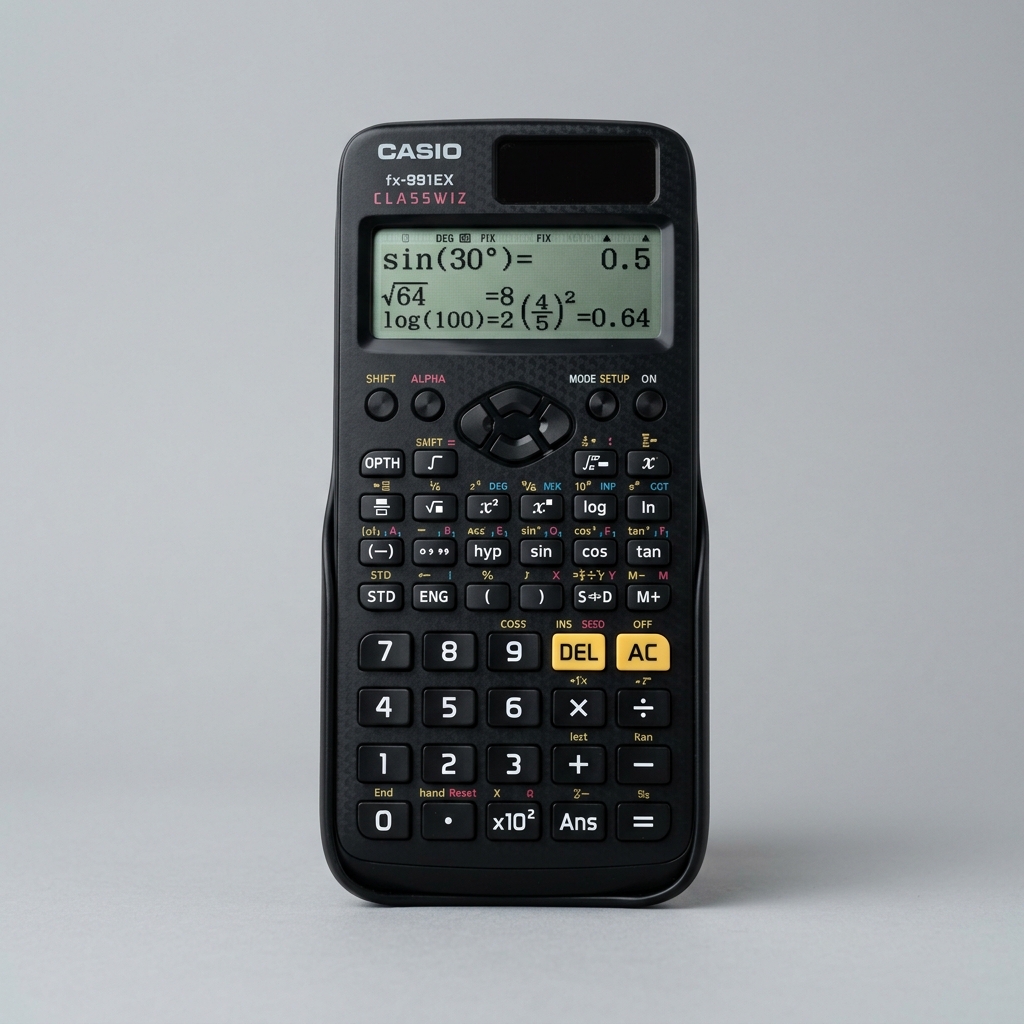
The #1 recommended scientific calculator for board exams, college chemistry, physics, and laboratory classes.
As an Amazon Associate we earn from qualifying purchases.
Calculate net force, mass, or acceleration using Newton's second law of motion (F = ma).
Calculate average velocity, distance traveled, or time interval using the formula v = d/t.
Calculate constant acceleration using initial velocity, final velocity, and time.
Did you find these formulas useful? You can bookmark this page (press Ctrl+D) to access it instantly anytime, copy the live URL overrides, or even embed a fully interactive responsive widget on your own blog.
Convert between mass and chemical moles using molecular formula weights.
Calculate number of chemical moles (n = m / M) using sample mass in grams and molecular weight (molar mass).
The fundamental stoichiometric relationship n = m / M converts between measurable mass (m, in grams) and chemical quantity (n, in moles) using the molar mass (M, in g/mol) as the bridge. This is the most commonly used equation in quantitative chemistry.
In a balanced chemical equation, coefficients give mole ratios between substances. For example, in 2H₂ + O₂ → 2H₂O, 2 moles of H₂ react with 1 mole of O₂ to produce 2 moles of H₂O. To predict how much product forms from a given mass of reactant, first convert mass to moles, apply the mole ratio, then convert back to mass if needed.
Balanced equations follow the Law of Conservation of Mass — atoms are neither created nor destroyed in chemical reactions. The same number of each type of atom must appear on both sides.
Convert all reactant masses to moles, then divide by their equation coefficients. The reactant with the smallest ratio is the limiting reagent — it runs out first, capping the reaction.
Percent composition tells you the mass percentage of each element in a compound. Calculate by dividing each element's total mass contribution by the molar mass and multiplying by 100%.
Last updated: June 2026. All results are estimates for informational purposes only and do not constitute professional advice.
The relationship between the relative quantities of substances taking part in a reaction or forming a compound.
Calculate net force, mass, or acceleration using Newton's second law of motion (F = ma).
Calculate average velocity, distance traveled, or time interval using the formula v = d/t.
Calculate constant acceleration using initial velocity, final velocity, and time.
Calculate the momentum of a moving object using its mass and velocity.
Disclaimer: This Stoichiometry Moles Calculator tool is provided strictly for educational and illustrative purposes. Calculations are derived using standard physical equations and chemical stoichiometric ratios. While the tool outputs precise solutions based on exact input values, floating-point rounding limits in code may introduce minor decimal deviations. All values should be checked independently for academic, research, or laboratory submissions. All calculations are performed entirely in your browser — no data is sent to our servers.