Loading NexProTools...
Preparing interactive calculation engine
Preparing interactive calculation engine
Solve electrical circuit equations using Ohm's Law (V = IR) and Electric Power (P = VI).
Deterministic Mathematical Simulation Engine • Client-Side Computation
Solve electrical circuit equations using Ohm's Law (V = IR) and Electric Power (P = VI).
| Parameter | Value | Unit |
|---|---|---|
| Electric Current (I) | 2.5 | A |
| Resistance (R) | 10 | Ω |
| Metric | Calculated Output |
|---|---|
| Calculated Voltage (V) | 25 |
| Electric Power (P) | 62.5 |
Want to use this tool on your own blog or website? Copy the code below to embed a fully interactive responsive version instantly.
This Electricity Ohm's & Power Calculator tool is provided strictly for educational and illustrative purposes. Calculations are derived using standard physical equations and chemical stoichiometric ratios. While the tool outputs precise solutions based on exact input values, floating-point rounding limits in code may introduce minor decimal deviations. All values should be checked independently for academic, research, or laboratory submissions.
Personalized Actionable Insights
Your circuit operates at 25.00 volts with a power dissipation of 62.50 watts — a moderate-power (typical household devices) load. These values govern thermal design, component selection, and safety ratings in electrical systems.
Check component ratings: Ensure your resistors, wires, and switches are rated above the calculated voltage and wattage.
Verify power supply specs: Confirm your power source can supply at least this wattage with a 20% safety margin.
Use in series/parallel: For complex circuits, apply Kirchhoff's Laws alongside Ohm's Law for multi-branch analysis.
Understand the logic under the hood. Here is the formula and exact variable mappings utilized by the Electricity Ohm's & Power Calculator to compile results.
ELECTVOLTAGE = electCurrent * electResistance
The Electricity Ohm's & Power Calculator processes mathematical rules to calculate instant results. By taking inputs, applying standard parameters, and updating equations, it yields precise values without manual accounting errors.
Adjustable user parameter. Enter a valid value between 0 and unlimited (Default value: 2.5A).
Adjustable user parameter. Enter a valid value between 0 and unlimited (Default value: 10Ω).
Our Electricity Ohm's & Power Calculator executes robust algorithmic code to deliver instant, entertainment-optimized calculations for social sharing and reflex stats.
See the calculation in action. Below is a step-by-step mathematical example using default parameters to demonstrate how values are processed and generated.
Initialize all calculator inputs with their official default values: Electric Current (I) = 2.5A, Resistance (R) = 10Ω.
The engine compiles the parameters and triggers the formulas in the calculation library.
Under this standard setup, the calculator yields: Calculated Voltage (V): 25, Electric Power (P): 62.5.
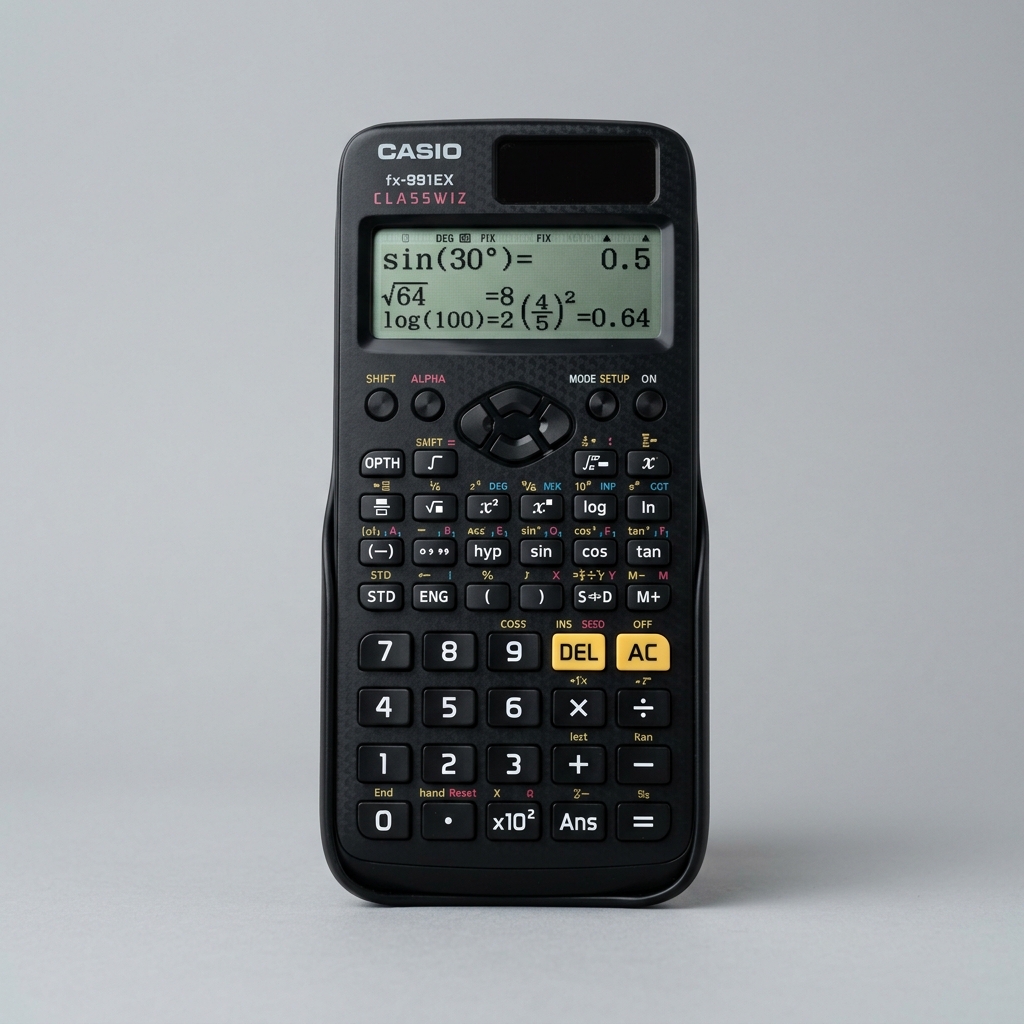
The #1 recommended scientific calculator for board exams, college chemistry, physics, and laboratory classes.
As an Amazon Associate we earn from qualifying purchases.
Calculate net force, mass, or acceleration using Newton's second law of motion (F = ma).
Calculate average velocity, distance traveled, or time interval using the formula v = d/t.
Calculate constant acceleration using initial velocity, final velocity, and time.
Did you find these formulas useful? You can bookmark this page (press Ctrl+D) to access it instantly anytime, copy the live URL overrides, or even embed a fully interactive responsive widget on your own blog.
Calculate electrical voltage, current, resistance, and wattage power in series circuits.
Solve electrical circuit equations using Ohm's Law (V = IR) and Electric Power (P = VI).
Ohm's Law (V = IR) states that the voltage across a conductor is proportional to the current flowing through it, with resistance as the proportionality constant. V is voltage in Volts, I is current in Amperes, and R is resistance in Ohms. The formula can be rearranged: I = V/R or R = V/I.
Electric power (P) is the rate of electrical energy dissipation. The primary formula is P = V × I (Watts). By substituting Ohm's Law, you get two equivalent forms: P = I²R (useful when current and resistance are known) and P = V²/R (useful when voltage and resistance are known). These formulas are essential for sizing wires, choosing fuses, and calculating electricity bills.
Resistance depends on the cross-sectional area of the conductor: R = ρL/A. A thicker wire has a larger area (A), reducing resistance. This is why high-current appliances use thicker cables — to minimize energy loss as heat.
A short circuit occurs when current bypasses the intended path through a very low resistance connection. Since R ≈ 0, current becomes extremely large (I = V/R → ∞), generating dangerous heat. Circuit breakers and fuses protect against this.
Multiply the power consumption (in kW) by usage time (in hours) to get kWh. Then multiply by your utility rate: Cost = Power (kW) × Time (h) × Rate (₹/kWh or $/kWh). A 1,500W heater running 8 hours at ₹6/kWh costs: 1.5 × 8 × 6 = ₹72.
Last updated: June 2026. All results are estimates for informational purposes only and do not constitute professional advice.
Calculate net force, mass, or acceleration using Newton's second law of motion (F = ma).
Calculate average velocity, distance traveled, or time interval using the formula v = d/t.
Calculate constant acceleration using initial velocity, final velocity, and time.
Calculate the momentum of a moving object using its mass and velocity.
Calculate mechanical power generated using work done and elapsed time.
Disclaimer: This Electricity Ohm's & Power Calculator tool is provided strictly for educational and illustrative purposes. Calculations are derived using standard physical equations and chemical stoichiometric ratios. While the tool outputs precise solutions based on exact input values, floating-point rounding limits in code may introduce minor decimal deviations. All values should be checked independently for academic, research, or laboratory submissions. All calculations are performed entirely in your browser — no data is sent to our servers.