Loading NexProTools...
Preparing interactive calculation engine
Preparing interactive calculation engine
Enter a circle radius to instantly solve diameter, boundary circumference, and surface area.
Deterministic Mathematical Simulation Engine • Client-Side Computation
Enter a circle radius to instantly solve diameter, boundary circumference, and surface area.
| Parameter | Value | Unit |
|---|---|---|
| Circle Radius (r) | 5 | — |
| Metric | Calculated Output |
|---|---|
| Diameter (d) | 10 |
| Circumference (C) | 31.416 |
| Circle Area (A) | 78.54 |
Want to use this tool on your own blog or website? Copy the code below to embed a fully interactive responsive version instantly.
This Circle Calculator tool is provided strictly for educational and illustrative purposes. Calculations are derived using standard geometric and algebraic axioms. While the tool outputs precise solutions based on exact input values, floating-point rounding limits in code may introduce minor decimal deviations. All values should be checked independently for academic or engineering submissions.
CIRCLE GEOMETRY:
      ___
    /     \
   |   r─► |   Radius: 5
    \  │  /
      ───      Diameter: 10
Circumference: 31.416 | Area: 78.54Personalized Actionable Insights
Your circle has a diameter of 10.0000, a circumference (perimeter) of 31.4160 units, and an enclosed area of 78.5400 square units. The circle is the most area-efficient shape for a given perimeter — this is why cells, pipes, and tanks are often circular.
Apply to pipe sizing: The area of a circular cross-section determines fluid flow capacity (Q = A × velocity). Doubling radius quadruples area and flow.
Use circumference for arc length: Arc length = (angle/360°) × circumference. Use this for sector problems, gears, and wheel rotations.
Scale: 1 revolution of a wheel = 1 circumference of travel. Divide total distance by circumference to find number of rotations.
Understand the logic under the hood. Here is the formula and exact variable mappings utilized by the Circle Calculator to compile results.
Area = PI * r^2; Circumference = 2 * PI * r
Solves circular dimensions using Pi ratio multipliers.
The radius distance
Our Circle Calculator executes robust algorithmic code to deliver instant, entertainment-optimized calculations for social sharing and reflex stats.
See the calculation in action. Below is a step-by-step mathematical example using default parameters to demonstrate how values are processed and generated.
Diameter = 10
Circumference = 31.4159
Area = 78.5398
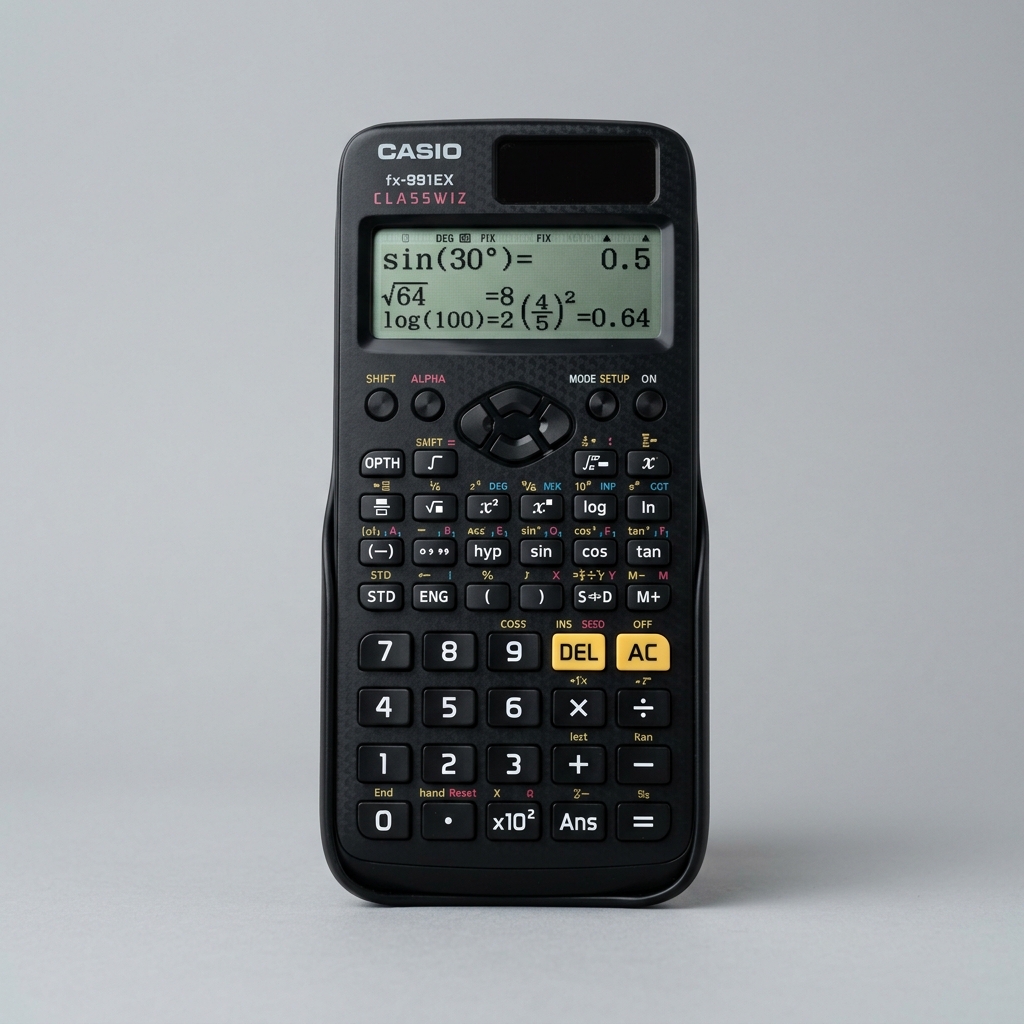
The #1 recommended scientific calculator for board exams, college algebra, mathematics, and engineering classes.
As an Amazon Associate we earn from qualifying purchases.
Perform arithmetic operations on fractions: add, subtract, multiply, and divide two fractions. Simplifies the results dynamically and provides decimal equivalencies.
Convert any positive or negative decimal value into its simplest fraction form, showing both proper/mixed fractions and percentages.
Simplify given ratios to their simplest form, or solve for missing variables to compute equivalent proportions. Our free calculator also handles scaling up or down, and helps solve complex ratio problems instantly.
Did you find these formulas useful? You can bookmark this page (press Ctrl+D) to access it instantly anytime, copy the live URL overrides, or even embed a fully interactive responsive widget on your own blog.
Compute circle diameter, circumference and area instantly from radius.
Enter a circle radius to instantly solve diameter, boundary circumference, and surface area.
Last updated: June 2026. All results are estimates for informational purposes only and do not constitute professional advice.
Step-by-step quadratic equation solver with real-time SVG parabola graphing.
Calculate 3D vector dot products, cross products, angles, and 2x2 determinants.
Calculate your semester GPA (Grade Point Average) dynamically based on grades and credit hours for up to 4 courses.
Calculate the minimum final exam grade required to achieve your target letter grade or percentage in a course.
Calculate your overall course grade by combining assignment categories and their respective percentage weights.
Disclaimer: This Circle Calculator tool is provided strictly for educational and illustrative purposes. Calculations are derived using standard geometric and algebraic axioms. While the tool outputs precise solutions based on exact input values, floating-point rounding limits in code may introduce minor decimal deviations. All values should be checked independently for academic or engineering submissions. All calculations are performed entirely in your browser — no data is sent to our servers.