Loading NexProTools...
Preparing interactive calculation engine
Preparing interactive calculation engine
Standard NCERT & CBSE aligned study curriculum. Master concepts, track accuracy, revise weak areas, and challenge yourself with 9 customized practice modes.
This topic is taught in multiple grades. Switch classes to see specific curriculum details:
Syllabus Sections
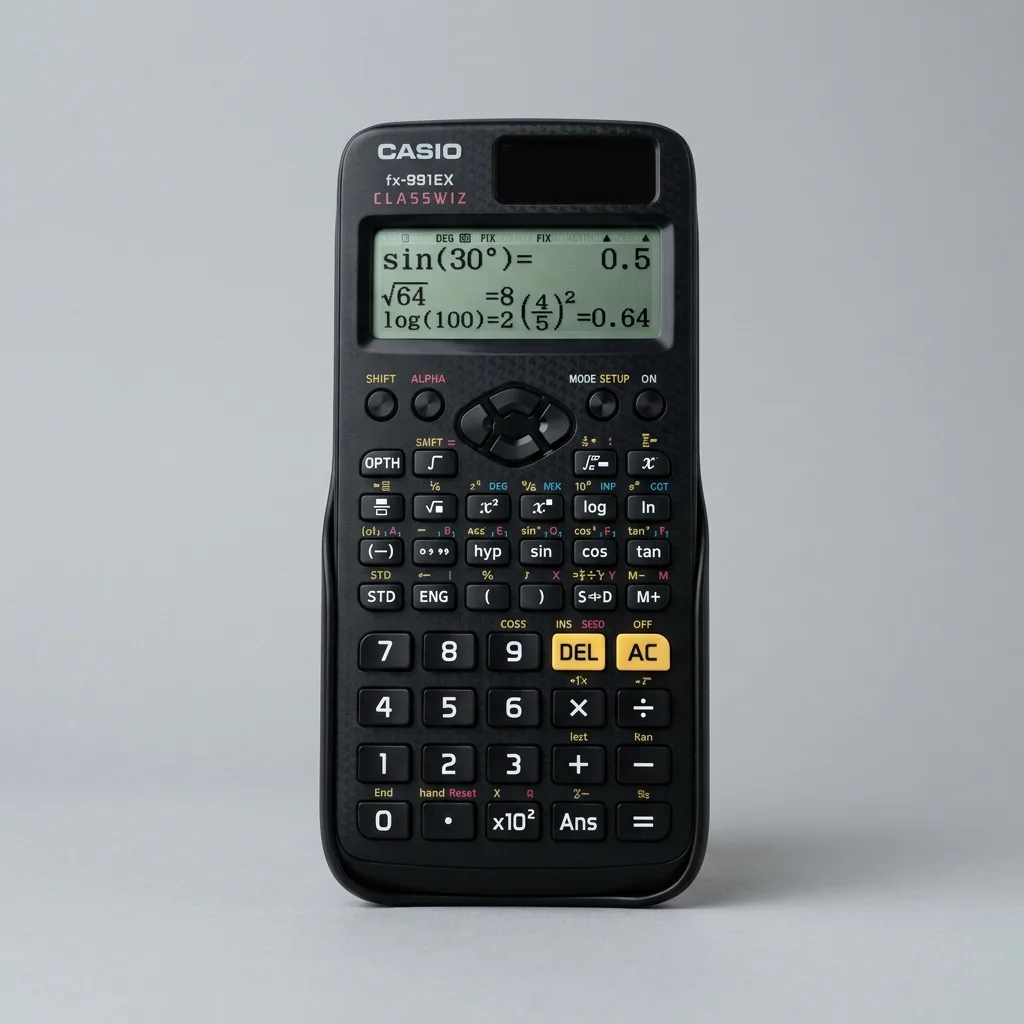
The #1 recommended scientific calculator for board exams, math, and physics.
As an Amazon Associate we earn from qualifying purchases.
Welcome to Class IX Mathematics: Surface Areas and Volumes. This chapter forms a core structural component of the math syllabus, designed to build analytical rigor and key formula models.
Use the detailed subtopic guide below to review standard definitions, key mathematical rules, and study guidelines.
This comprehensive study guide for Surface Areas and Volumes is designed for Class IX students following the CBSE and NCERT Mathematics curriculum. It covers 4 key subtopics including Surface area of sphere and hemisphere, Surface area of right circular cone, Volume of cone, sphere, and hemisphere, and 1 more essential concepts. Whether you are preparing for school examinations, CBSE board exams, or competitive tests, this resource provides everything you need to build a strong conceptual foundation and achieve mastery.
The chapter includes 3 key formulas and equations, 1 fully worked step-by-step example problems, interactive practice exercises across 9 difficulty categories, timed mock quizzes, and downloadable worksheets. Each topic is explained with detailed concept definitions, mathematical representations, and expert study guidelines to help you understand not just the "how" but the "why" behind every formula and method.
Mathematics is a subject that rewards consistent practice and conceptual clarity over rote memorization. As you work through this chapter on Surface Areas and Volumes, focus on understanding the underlying principles first, then gradually increase problem difficulty. Use the practice sections to identify and strengthen weak areas, and refer to the common mistakes section to avoid the pitfalls that most students encounter.
By the end of studying Surface Areas and Volumes for Class IX, you will have developed proficiency in the following learning outcomes as outlined by the NCERT syllabus:
Calculate curved and total surface area of cones and spheres.
Determine volume capacity of hemispheres.
Solve melting/recasting volume word problems.
Before studying Surface Areas and Volumes, make sure you are comfortable with the following prerequisite concepts. A strong foundation in these areas will help you understand new topics faster and solve problems more confidently:
If any of these prerequisites feel unfamiliar, consider reviewing them first using the Related Chapters section at the bottom of this page. Building a solid base ensures you can tackle Surface Areas and Volumes with full confidence.
Students often wonder “Where will I use Surface Areas and Volumesin real life?” The answer is: everywhere. The mathematical concepts you learn in this chapter have practical applications across science, engineering, technology, medicine, finance, and everyday problem-solving. Here are some notable examples:
Companies optimize material usage by calculating surface areas for packaging boxes, cans, and bottles to minimize production costs.
Architects calculate volumes of rooms and buildings for ventilation design, and surface areas for painting and material estimation.
Municipal engineers calculate tank volumes to ensure adequate water storage capacity for growing populations.
Factories compute volumes for casting molds and surface areas for coating processes in metal, plastic, and glass production.
Understanding the real-world relevance of Surface Areas and Volumes not only makes learning more engaging but also helps you appreciate how mathematical thinking is a superpower that opens doors in virtually every career path — from engineering and medicine to finance and technology.
Follow these expert study strategies to maximize your understanding and exam performance in this chapter. These tips are specifically tailored for the type of content covered in Surface Areas and Volumes:
Sketch a clear, labeled diagram for every geometry problem before writing equations. A good diagram often reveals the solution approach immediately and prevents misidentification of sides and angles.
Use different colored pens for different elements — one color for given information, another for what you need to find, and a third for construction lines. This visual separation dramatically reduces confusion.
Learn to recognize common geometric configurations (30-60-90 triangles, isosceles properties, tangent-radius perpendicularity) instantly. Pattern recognition speeds up problem-solving significantly.
Pro Tip: Consistency beats intensity. Studying Surface Areas and Volumes for 30 minutes daily is far more effective than cramming for 5 hours before the exam. Use the practice sections below to build muscle memory through regular problem-solving.
Review detailed conceptual explanations, mathematical equations, and guidelines for each subtopic in this chapter:
A sphere is a perfectly round 3D solid. A hemisphere is half of a sphere. The curved surface area of a hemisphere is 2πr², and its total surface area (including the flat circular base) is 3πr².
The curved surface area of a right circular cone is πrl, where r is the radius and l is the slant height. The total surface area adds the area of the circular base: πrl + πr².
Volume measures the 3D space occupied by a solid. The volume of a cone is one-third that of a cylinder with the same radius and height. The volume of a sphere is (4/3)πr³, and a hemisphere is half of that.
Mensuration word problems involve applying surface area and volume formulas to real-world scenarios, such as finding the cost of painting a dome, the amount of canvas for a tent, or the capacity of a water tank.
By the end of this chapter, students will be able to master and solve questions on these outcomes:
Calculate curved and total surface area of cones and spheres.
Determine volume capacity of hemispheres.
Solve melting/recasting volume word problems.
Volume capacity of sphere.
Total outer surface area of sphere.
Volume of right circular cone.
[From Heron's Formula] Calculates triangle area using semi-perimeter s and sides a, b, c.
Solve trigonometric, exponential, logarithmic, and root functions for standard algebraic values.
Deterministic Mathematical Simulation Engine • Client-Side Computation
Solve trigonometric, exponential, logarithmic, and root functions for standard algebraic values.
| Parameter | Value | Unit |
|---|---|---|
| Value (X) | 45 | — |
| Function | sin | — |
| Metric | Calculated Output |
|---|---|
| Function Output | 0.707 |
MATH SOLVER RUNNING:
 [Inputs] ──► [Mathematical Formula] ──► [Outputs]
  Processed elements successfully.
📚 Level up by completing practice sets.
100% Mastery
No weak areas logged!
Simple algebraic checks with hints and solutions enabled.
Standard curriculum queries matching board exam templates.
Complex math application questions with numeric inputs.
5 mixed questions with a ticking clock to evaluate speed.
Specialized assessment matching the printed worksheets.
Strict 10-question chapter exam. Hints are disabled.
Combines prerequisite concepts and related chapter formulas.
Original questions from previous year CBSE board exams.
High-order logical problems matching Olympiad standards.
Test your math skills with this 5-question chapter mock exam. A live ticking clock will monitor your performance.
Review and solve 1 real Board paper questions from the 3 mock sample sets matching Surface Areas and Volumes.
The radii of two cylinders are in the ratio 2 : 3 and their heights are in the ratio 5 : 3. Find the ratio of their total surface areas.
Recognizing and eliminating common errors is a key step to scoring high marks in school and board exams:
Using area equations when calculating the outer boundary lines, or vice versa.
Calculating volumes by multiplying cm by meters directly without converting all inputs to the same unit first.
Confusing flat 2D geometries (circles) with 3D solid geometries (spheres) in word problems.
2D shapes have perimeter and area (flat space). 3D solids have surface area and volume (volumetric capacity).
Lengths use cm/m; areas use cm²/m²; volumes use cm³/m³ or liters.
The constant π (approx 3.14159 or 22/7) represents the ratio of circle circumference to its diameter.
Ensure all prerequisite concepts are fully understood before working on advanced calculations.
Always check equations step-by-step to avoid simple sign and arithmetic errors.
Resolve equations using alternative methods (e.g., check quadratic roots by plugging them back into ax² + bx + c), verify decimals using scientific solvers, and review step-by-step worked calculations.
Trigonometry is used in architecture, mechanics and navigation. Quadratic equations model rocket trajectories and profit boundaries. Basic arithmetic and fractions are applied in accounting, budgeting and lab chemistry.
Check out these related chapters and pre-requisites to strengthen your analytical foundation:
Use these related calculator solvers to verify variables and double check homework steps:
Select any key syllabus topic below to open its detailed learning guide, worked models, and study guidelines.
Solve binomial and trinomial algebraic expressions.
A complete study guide to CBSE Grade 9 triangle geometry.
Learn axes, quadrants, coordinates, and lines mapping.
Generate and print a beautiful chapter worksheet complete with key equations, problems, and dedicated writing spaces.
1. The radii of two cylinders are in the ratio 2 : 3 and their heights are in the ratio 5 : 3. Find the ratio of their total surface areas.
2. A student was asked to make a model shaped like a cylinder with two cones attached to its ends by using a thin aluminium sheet. The diameter of the model is 3 cm and its total length is 12 cm. If each cone has a height of 2 cm, find the volume of air contained in the model.
3. The ratio of their surface areas is (a) 3:4 (b) 4:3 (c) 9:16 (d) 16:9
4. From a solid cylinder whose height is 2.4 cm and diameter 1.4 cm, a conical cavity of the same height and same diameter is hollowed out. Find the total surface area of the remaining solid to the nearest cm2.
5. (a) Two cubes each of volume 125 cm 3 are joined end to end. Find the volume and the surface area of the resulting cuboid.