Grammar accounts for 25% of your IELTS Writing score and a significant portion of your Speaking score. It is assessed under Grammatical Range and Accuracy — and the name tells you exactly what examiners are looking for: range (variety of structures) and accuracy (using them correctly).
Most IELTS candidates know basic grammar. The difference at Band 7 is knowing how to deploy a wider range of sentence structures without making errors. This guide gives you the 12 grammar rules that most directly affect IELTS band scores, with the exact errors examiners see most often and the corrected versions.
After reading, test your grammar knowledge at NexPro's Grammar Hub — 15 topic areas with timed quizzes and instant explanations.
What Grammatical Range and Accuracy Means at Each Band
- Band 5 — Uses a limited range of structures. Many errors that cause difficulty for the reader.
- Band 6 — Uses a mix of simple and complex structures, but makes errors that sometimes cause the reader difficulty.
- Band 7 — Uses a variety of complex structures. Produces frequent error-free sentences. Makes only occasional errors or inappropriacies.
- Band 8 — Uses a wide range of structures. The majority of sentences are error-free. Makes only occasional unsystematic errors.
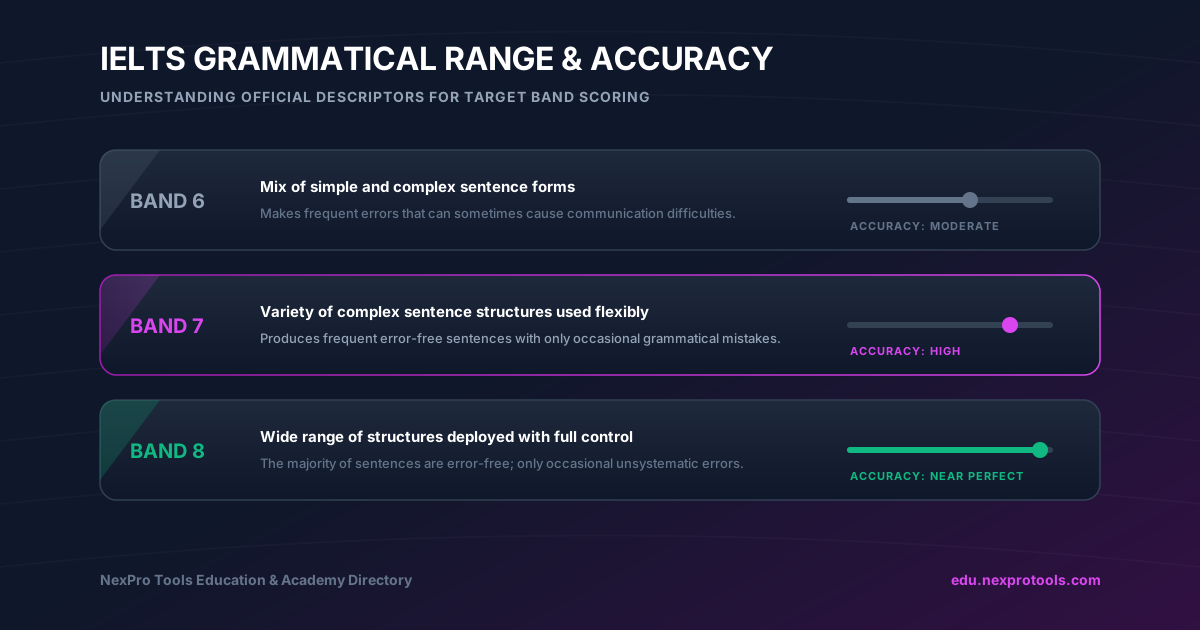
The jump from Band 6 to Band 7 requires two things: introducing more complex structures (not just subject-verb-object sentences) and reducing the frequency of errors to occasional rather than systematic.
Rule 1: Subject-Verb Agreement
The verb must agree in number with its subject. This sounds basic — and it is — but it is one of the most common error types in IELTS essays, particularly when the subject is separated from the verb by a long phrase.
Wrong: The number of students who fail the examination are increasing. Correct: The number of students who fail the examination is increasing.
The subject is "the number" (singular), not "students". The relative clause "who fail the examination" sits between the subject and verb but does not change the subject.
Wrong: Each of the proposals have merit. Correct: Each of the proposals has merit.
"Each" is always singular. Similarly: "everyone", "nobody", "either", "neither", "anyone", "someone".
IELTS tip: When writing long sentences, identify your subject before choosing your verb. Do not be misled by the nearest noun.
Rule 2: Articles (a / an / the / zero article)
Articles are one of the most consistently tested grammar points in IELTS, and one of the most frequently misused by test-takers. English has three article situations:
- Definite article (the) — Use when referring to something specific or already known to the reader. E.g. The government should fund the programme. (A specific programme already mentioned.)
- Indefinite article (a / an) — Use when introducing something for the first time, or when referring to one unspecified member of a category. E.g. This requires a significant change in policy.
- Zero article — Use with plural countable nouns and uncountable nouns when speaking in general. E.g. Education is important. (Not The education is important.) or Technology has changed our lives.
Common IELTS errors and corrections:
- Wrong: The government should invest in the education. → Correct: ...invest in education. (Rule: Zero article for general uncountable)
- Wrong: This is an unique opportunity. → Correct: ...a unique opportunity. (Rule: "unique" starts with /j/ consonant sound, not a vowel sound)
- Wrong: Government must take action. → Correct: The government must take action. (Rule: Specific unique institution = "the")
- Wrong: The air pollution is a global problem. → Correct: Air pollution is a global problem. (Rule: General concept = zero article)
Rule 3: Tense Consistency
IELTS Task 2 essays are primarily written in the simple present when discussing facts, trends, opinions, and arguments. The most common error is unintentionally slipping into past tense.
Wrong: Many people believed that online education was beneficial because it provided flexibility. Correct: Many people believe that online education is beneficial because it provides flexibility.
Use past tense only when: referring to a historical event, discussing something that has changed, or giving a specific example from the past.
Correct use of past tense: In the 1990s, most employees worked in offices. Today, remote work has become the norm.
Rule 4: Conditional Sentences
Conditionals are a key marker of grammatical range. Using them correctly in an IELTS essay — especially the second conditional for hypothetical arguments — demonstrates sophisticated control.
- First conditional (real / likely situation): If the government invests in renewable energy, it will reduce carbon emissions significantly.
- Second conditional (hypothetical / unlikely): If every individual reduced their carbon footprint, the global impact would be substantial.
- Third conditional (past hypothetical): If stricter regulations had been introduced earlier, the environmental damage could have been avoided.
Common error — mixing first and second: Wrong: If the government would invest in education, outcomes will improve. Correct: If the government invested in education, outcomes would improve.
IELTS tip: Use the second conditional when you want to argue a hypothetical — "If every country adopted this policy..." — to show range without committing to a claim you cannot support.
Rule 5: Passive Voice
The passive voice is a hallmark of academic English. Using it correctly in Task 2 shows control of formal register. Overusing it makes your writing sound unnatural.
Formation: subject + be (conjugated) + past participle. E.g. The policy was introduced in 2019. or Resources are allocated unequally across different regions.
- When the agent (the "doer") is unknown or unimportant: Thousands of jobs are lost each year to automation.
- When you want to foreground the effect rather than the cause: Children are exposed to violent content through social media.
- When writing about general truths: It is widely believed that education is the foundation of economic development.
Common error — forming passive incorrectly: Wrong: The problem is needed to be solved urgently. Correct: The problem needs to be solved urgently. (or: The problem must be addressed urgently.)
Rule 6: Relative Clauses
Relative clauses allow you to embed information inside a sentence without starting a new one. They are a key marker of complex sentence structure.
-
Defining (no commas): Identifies which person or thing you mean. E.g. Students who study in overcrowded classrooms perform significantly worse on standardised tests.
-
Non-defining (with commas): Adds extra information about something already identified. E.g. Finland, which consistently tops global education rankings, invests heavily in teacher training.
-
Wrong: The country which it has the highest literacy rate... → Correct: The country which has the highest literacy rate... (Problem: Remove "it" — the relative pronoun replaces the subject)
-
Wrong: The policy, that was introduced last year... → Correct: The policy, which was introduced last year... (Problem: Use "which" not "that" in non-defining clauses)
-
Wrong: The students who they passed the exam... → Correct: The students who passed the exam... (Problem: Remove "they")
Rule 7: Gerunds and Infinitives
Many verbs in English are followed either by a gerund (verb + -ing) or an infinitive (to + verb), and the choice is not interchangeable. Using the wrong form is a systematic error that lowers your accuracy score.
- Verbs followed by gerund: avoid, consider, deny, enjoy, finish, involve, recommend, suggest. E.g. The government should consider introducing a sugar tax. or Experts recommend reducing screen time for children under 12.
- Verbs followed by infinitive: agree, decide, expect, fail, hope, manage, refuse, tend. E.g. Many countries have failed to address the housing crisis effectively. or Governments tend to prioritise short-term economic gains over long-term environmental goals.
- Verbs that take both (with different meanings): stop doing (cease an activity) vs. stop to do (pause in order to do something); remember doing (recall a past event) vs. remember to do (not forget a future task).
Rule 8: Complex Noun Phrases
Band 7+ writing uses noun phrases that pack multiple descriptors around a noun. This creates precision without using multiple short sentences.
- Simple: There is a big problem with the system. → Band 7: There is a fundamental structural flaw in the current healthcare system.
- Simple: We need changes to the policy. → Band 7: A series of comprehensive, long-term policy reforms is urgently required.
Build complex noun phrases by combining: quantifier + adjective(s) + noun + post-modifier. E.g. a significant reduction in carbon emissions, a wide range of evidence-based interventions, or the disproportionate burden placed on lower-income households.
Rule 9: Concessive Clauses
Concessive clauses allow you to acknowledge an opposing view before dismissing or qualifying it — a key feature of Band 7 argumentation.
- Although / Even though (at the start of the clause): Although online learning offers undeniable flexibility, it cannot replicate the social development that physical classrooms provide.
- Despite / In spite of (followed by a noun phrase or gerund, NOT a subject + verb): Wrong: Despite the government has invested heavily... Correct: Despite the government's heavy investment... or Despite investing heavily, the government has not...
- While (for simultaneous contrast): While technology creates new employment opportunities, it simultaneously eliminates a greater number of existing roles.
Rule 10: Cleft Sentences for Emphasis
Cleft sentences are rarely taught in general English classes, but they are a powerful marker of advanced grammar range. They restructure a sentence to emphasise one element.
- Standard: Government investment is most needed in early childhood education. → Cleft: It is government investment that is most needed in early childhood education.
- Standard: Social media has driven the increase in misinformation. → Cleft: It is social media that has been the primary driver of the increase in misinformation.
Use one cleft sentence per essay — it signals sophisticated grammatical control without feeling forced.
Rule 11: Reported Speech and Academic Distance
IELTS essays frequently require you to reference what "some people believe" or what "researchers suggest". Using reported speech correctly creates academic tone and distance.
- Reporting verbs for IELTS: argue, assert, claim, contend, maintain, suggest, acknowledge, concede.
- Backshifting (when the reporting verb is past tense): Researchers found that students performed significantly better in smaller classes. or Critics argued that the policy had failed to address the root causes.
- No backshifting (when reporting a current belief or general truth): Many educators argue that standardised testing narrows the curriculum. or Proponents of this view claim that renewable energy is economically viable.
Rule 12: Parallel Structure
Parallel structure means that elements in a list or comparison must use the same grammatical form. Violating it is one of the most common accuracy errors in Band 5–6 essays.
Wrong: The policy aims to reduce costs, improving efficiency, and it creates more jobs. Correct: The policy aims to reduce costs, improve efficiency, and create more jobs.
Wrong: Education is not only important for economic growth but also for creating social equality. Correct: Education is important not only for economic growth but also for social equality.
The rule: items joined by "and", "or", "but also", "neither...nor", "either...or" must be the same grammatical form (all verbs, all nouns, all adjectives).
Your Grammar Practice Plan for IELTS
- Week 1–2: Master Rules 1, 2, 3, and 5 (agreement, articles, tense, passive). These account for the majority of systematic errors in Band 5–6 essays.
- Week 3–4: Practise Rules 4, 6, and 9 (conditionals, relative clauses, concessive clauses). These are the structures that signal a move from simple to complex sentences.
- Week 5–6: Introduce Rules 8, 10, and 12 (complex noun phrases, cleft sentences, parallel structure). These are the markers of Band 7+ grammatical range.
After practising each rule, write a full Task 2 essay and use NexPro's AI Writing Evaluator to get your Grammatical Range and Accuracy score. The evaluator shows you exactly which sentences contain errors and how to rewrite them.
Test Yourself: Grammar Quiz
Test your understanding of these 12 rules with NexPro's Grammar Hub:
- Articles — 10-question timed quiz →
- Tenses — 10-question timed quiz →
- Active & Passive Voice →
- Clauses & Phrases →
- Subject-Verb Agreement →
Each quiz gives instant feedback with rule explanations after every answer — so you are learning grammar in context, not just testing what you already know.
Continue your IELTS preparation: