If you are preparing for IELTS in 2026, Writing Task 2 is the section that will make or break your band score. It counts for two-thirds of your entire Writing score, and it has the most predictable topic universe of any part of the exam.
This guide gives you every major topic category appearing in 2026, real question examples reported by test-takers, the essay types you must master, and the preparation strategy that separates Band 6 students from Band 7+ students. At the end, you can practice directly using NexPro's AI Writing Evaluator — paste your essay and get a full rubric-based score in seconds.
What is IELTS Writing Task 2?
Task 2 is a formal essay of at least 250 words written in 40 minutes. You are given a statement, argument, or question and asked to respond using organised ideas, relevant examples, and academic vocabulary. Both Academic and General Training candidates sit the same Task 2.
Your essay is marked on four equally weighted criteria:
- Task Response: Did you fully address the question? Did you take a clear position?
- Coherence and Cohesion: Is your essay logically organised with smooth paragraph flow?
- Lexical Resource: Do you use a wide, accurate, and varied range of vocabulary?
- Grammatical Range and Accuracy: Do you use complex sentence structures correctly?
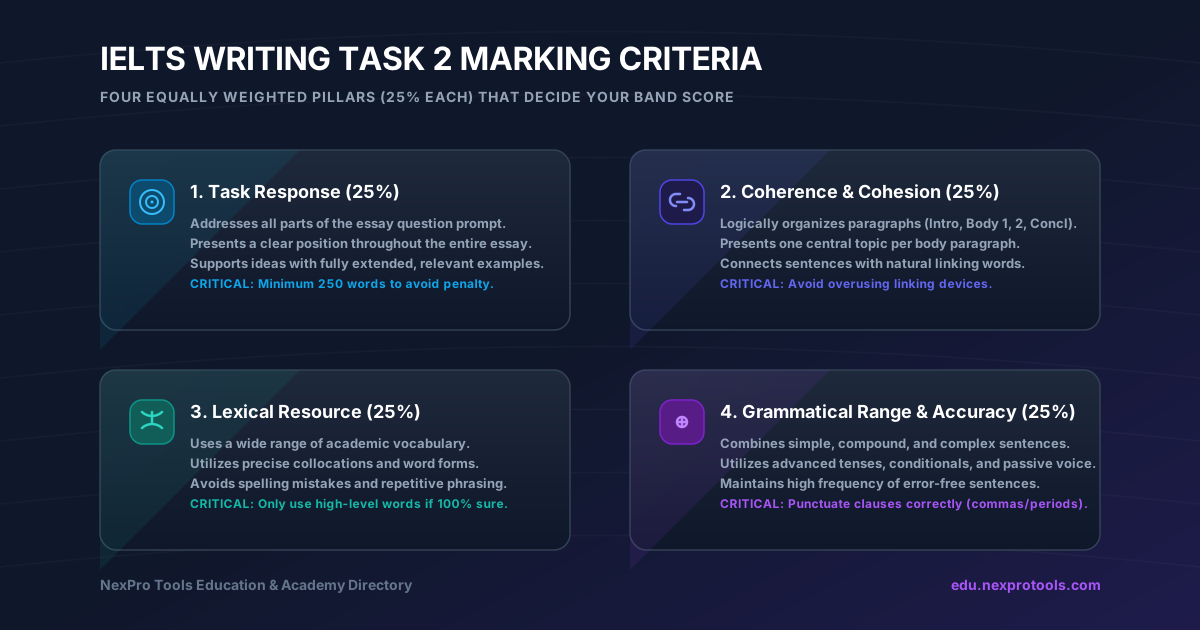
Each criterion is worth 25% of your Task 2 band score.
The 5 Question Types You Must Know
Every Task 2 question is one of five types. Before preparing topics, you must know the structure for each type — because the same topic can be asked in different formats.
1. Opinion Essay (Agree / Disagree)
"To what extent do you agree or disagree?" State your position clearly in the introduction. Maintain it throughout. Do not write "on the one hand... on the other hand" — that is a Discussion Essay structure, not an Opinion Essay.
2. Discussion Essay (Discuss Both Views)
"Discuss both views and give your own opinion." Dedicate one body paragraph to each view, then add your personal stance in the conclusion or a brief third paragraph. You must give an opinion — not giving one drops your Task Response score.
3. Problem and Solution Essay
"What are the causes of this problem? What solutions can be suggested?" One body paragraph per focus area: causes in paragraph one, solutions in paragraph two. Do not mix them.
4. Advantages and Disadvantages Essay
"Do the advantages outweigh the disadvantages?" This is different from a Discussion Essay. You are being asked to weigh up both sides and make a judgment. Your conclusion must declare which side wins.
5. Two-Part Question
"Why is this happening? Is this a positive or negative development?" Answer both parts explicitly. Missing either part significantly drops your Task Response score — the most common mistake in this type.
The 6 Core Topic Categories in 2026
Analysis of reported exam questions from January 2024 through June 2026 shows six topic clusters account for approximately 85% of all Task 2 prompts. Here they are, with the most commonly reported 2026 questions for each.
1. Education (~22% of all questions)
Education is consistently the most frequent category. In 2026, questions are focusing on online learning, the purpose of universities, and practical versus academic skills.
Real questions reported in 2026:
- Some people believe that online learning will completely replace traditional classroom teaching in the future. To what extent do you agree or disagree?
- Many people think that practical skills such as cooking, financial management, and home repairs should be taught in schools. Others believe that academic subjects are more important. Discuss both views and give your opinion.
- Should university education be free for all students, funded by the government? To what extent do you agree?
- Some educators believe that children are given too much homework. Others say homework is essential for academic success. Discuss both views.
Key vocabulary for Education essays: curriculum, pedagogy, rote learning, critical thinking, vocational training, academic achievement, lifelong learning, transferable skills, literacy rate, higher education, extracurricular, tuition fees, blended learning
Tip: For the online vs traditional learning question, avoid taking an extreme position. A balanced argument — acknowledging benefits of online flexibility while defending the irreplaceable social dimension of classrooms — scores higher than a one-sided essay.
2. Technology (~20% of all questions)
Technology topics have grown significantly since 2020, with artificial intelligence, social media, and automation now among the most frequently tested subtopics.
Real questions reported in 2026:
- Artificial intelligence will eliminate more jobs than it creates. To what extent do you agree or disagree?
- Social media has had a more negative effect on society than a positive one. Do you agree or disagree?
- Some people think that technology makes people less creative. Others think it enhances creativity. Discuss both views.
- Governments should regulate the use of social media platforms. To what extent do you agree?
Key vocabulary for Technology essays: automation, artificial intelligence, digital literacy, cybersecurity, algorithm, innovation, misinformation, surveillance, data privacy, remote work, digital divide, technological advancement, obsolete
Tip: The AI and employment question is a predicted high-frequency topic for the second half of 2026. Prepare arguments for both sides — that AI eliminates repetitive roles but creates new categories of skilled employment.
3. Environment (~18% of all questions)
Environmental questions in 2026 are increasingly asking candidates to assign responsibility — to governments, corporations, or individuals.
Real questions reported in 2026:
- Some people think that individuals can do nothing to address climate change and that only governments and large companies can make a difference. To what extent do you agree?
- The best way to solve the world's environmental problems is to increase the price of fuel. Do you agree or disagree?
- It is inevitable that as technology advances, traditional cultures and environments will be lost. Do you agree?
- Air pollution is a serious problem in many cities. What are the causes, and what measures can be taken to address it?
Key vocabulary for Environment essays: carbon footprint, renewable energy, sustainability, greenhouse gases, biodiversity, deforestation, climate change, fossil fuels, carbon tax, ecological impact, conservation, net zero, environmental legislation
Tip: The carbon tax question is a recurring topic. Prepare a balanced argument: discuss its effectiveness in reducing consumption while acknowledging the disproportionate burden it places on lower-income households.
4. Health (~15% of all questions)
Health topics in 2026 are focused on mental health, government responsibility for public health, and the affordability of nutritious food.
Real questions reported in 2026:
- Mental health problems are increasing among young people in many countries. What are the possible causes, and what can be done to address this problem?
- Governments should tax unhealthy foods and drinks to encourage people to eat more healthily. To what extent do you agree?
- Some people believe that the government is responsible for people's health and fitness. Others think that individuals should take responsibility themselves. Discuss both views.
Key vocabulary for Health essays: preventive healthcare, sedentary lifestyle, mental health, obesity, public health policy, well-being, diet-related disease, healthcare system, stress management, physical activity, nutritional value
5. Government and Society (~15% of all questions)
Real questions reported in 2026:
- In many countries, both men and women need to work full-time. Therefore, some people think household tasks should be shared equally. To what extent do you agree?
- Some people think that criminals should be given longer prison sentences. Others believe in rehabilitation. Discuss both views.
- Governments spend large amounts of money on public art. Many people think this is a waste of money. Do you agree?
6. Culture and Globalisation (~10% of all questions)
Real questions reported in 2026:
- International travel has led to the spread of diseases and crime. Do the disadvantages outweigh the advantages?
- Some people feel that the preservation of traditional cultures is more important than the adoption of a global culture. To what extent do you agree?
The Preparation Strategy That Actually Works
Most students prepare topics by memorising sample essays. Examiners are trained to detect this, and memorised content is penalised heavily — potentially dropping you a full band.
The effective strategy has three parts:
- Prepare ideas, not essays: For each of the six topic categories, write down five causes, five effects, and five possible solutions in your own words. You are building a personal idea bank, not memorising someone else's sentences.
- Master the 5 structures: Practice writing introductions and body paragraph topic sentences for each of the five question types. A flexible structure applied to any topic beats a memorised essay on a specific topic every time.
- Write timed drafts and get feedback: Aim for 270–300 words (not the minimum 250). Time yourself strictly to 40 minutes. Then use a scoring tool to identify which of the four criteria you are weakest on — and target that specifically.
Common Mistakes That Drop Your Band Score
- Writing under 250 words — automatic penalty for Task Response
- Not taking a clear position in Opinion Essays — examiners need to know what you think by the end of paragraph one
- Mixing causes and solutions in the same paragraph — each body paragraph must have one clear focus
- Opening with "In today's modern world..." — examiners have seen this phrase thousands of times; it signals a memorised response
- Using big words incorrectly — a simple word used correctly outscores a complex word used wrongly
Practice With NexPro's AI Writing Evaluator
The fastest way to improve is to get specific, rubric-based feedback on your own writing — not generic advice.
NexPro's AI Writing Evaluator scores your essay on all four IELTS criteria, identifies your weakest sentences, and shows you exactly how to rewrite them. Use it after every timed practice essay.
Take it further: