Loading NexProTools...
Preparing interactive calculation engine
Preparing interactive calculation engine
Standard NCERT & CBSE aligned study curriculum. Master concepts, track accuracy, revise weak areas, and challenge yourself with 9 customized practice modes.
Syllabus Sections
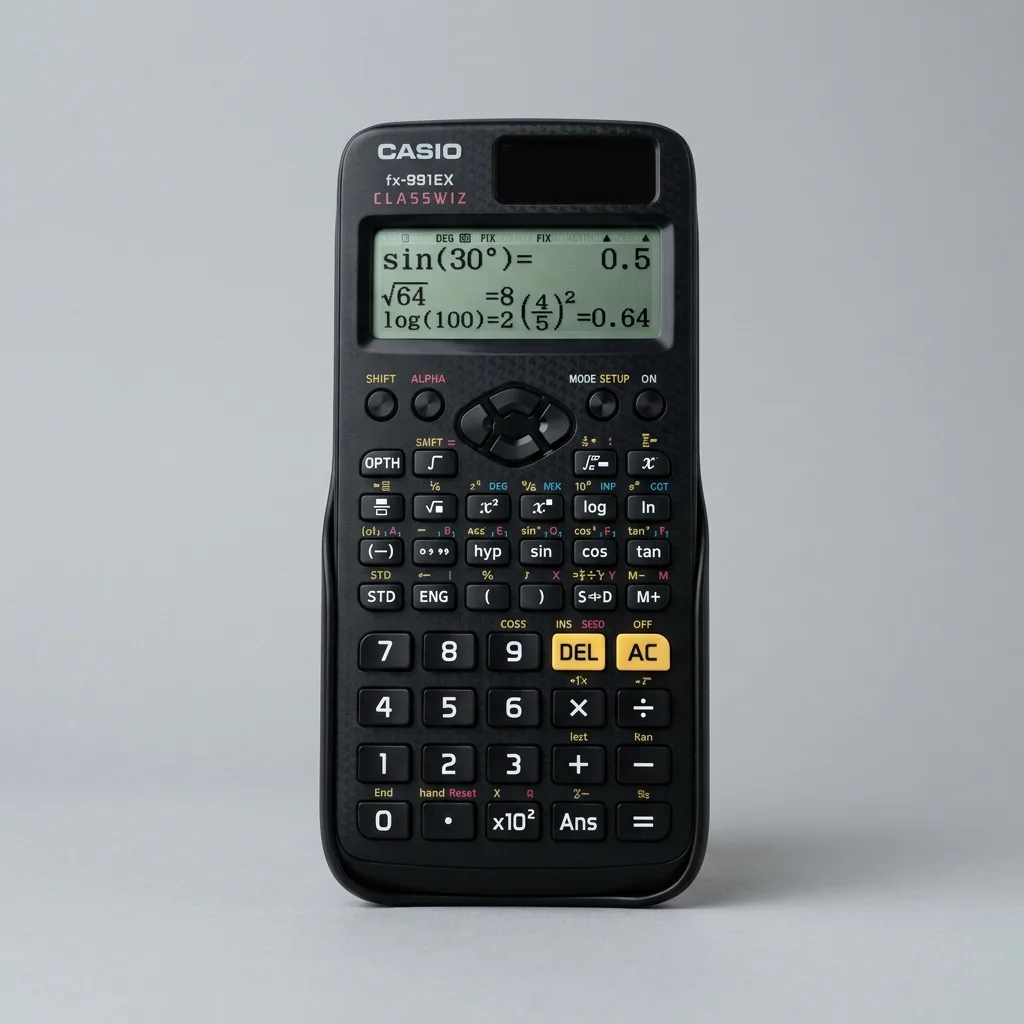
The #1 recommended scientific calculator for board exams, math, and physics.
As an Amazon Associate we earn from qualifying purchases.
Welcome to Class X Mathematics: Some Applications of Trigonometry. This chapter forms a core structural component of the math syllabus, designed to build analytical rigor and key formula models.
Use the detailed subtopic guide below to review standard definitions, key mathematical rules, and study guidelines.
This comprehensive study guide for Some Applications of Trigonometry is designed for Class X students following the CBSE and NCERT Mathematics curriculum. It covers 3 key subtopics including Line of sight, Angle of elevation, Angle of depression, Heights and Distances single-triangle problems, Two-triangle height calculations. Whether you are preparing for school examinations, CBSE board exams, or competitive tests, this resource provides everything you need to build a strong conceptual foundation and achieve mastery.
The chapter includes 1 key formulas and equations, 1 fully worked step-by-step example problems, interactive practice exercises across 9 difficulty categories, timed mock quizzes, and downloadable worksheets. Each topic is explained with detailed concept definitions, mathematical representations, and expert study guidelines to help you understand not just the "how" but the "why" behind every formula and method.
Mathematics is a subject that rewards consistent practice and conceptual clarity over rote memorization. As you work through this chapter on Some Applications of Trigonometry, focus on understanding the underlying principles first, then gradually increase problem difficulty. Use the practice sections to identify and strengthen weak areas, and refer to the common mistakes section to avoid the pitfalls that most students encounter.
By the end of studying Some Applications of Trigonometry for Class X, you will have developed proficiency in the following learning outcomes as outlined by the NCERT syllabus:
Define line of sight, elevation, and depression parameters.
Solve height-of-tower and width-of-river triangle problems.
Solve scenarios combining angles of 30, 45, and 60 degrees.
Before studying Some Applications of Trigonometry, make sure you are comfortable with the following prerequisite concepts. A strong foundation in these areas will help you understand new topics faster and solve problems more confidently:
If any of these prerequisites feel unfamiliar, consider reviewing them first using the Related Chapters section at the bottom of this page. Building a solid base ensures you can tackle Some Applications of Trigonometry with full confidence.
Students often wonder “Where will I use Some Applications of Trigonometryin real life?” The answer is: everywhere. The mathematical concepts you learn in this chapter have practical applications across science, engineering, technology, medicine, finance, and everyday problem-solving. Here are some notable examples:
Trigonometry enables measuring heights of towers, mountains, and buildings without physically climbing them, using angles of elevation and depression.
Pilots calculate descent angles and runway approach paths using trigonometric ratios for safe landings.
Astronomers measure distances to nearby stars using parallax angles and trigonometric calculations.
Builders calculate roof slopes, ramp gradients, and support beam angles using trigonometric applications.
Understanding the real-world relevance of Some Applications of Trigonometry not only makes learning more engaging but also helps you appreciate how mathematical thinking is a superpower that opens doors in virtually every career path — from engineering and medicine to finance and technology.
Follow these expert study strategies to maximize your understanding and exam performance in this chapter. These tips are specifically tailored for the type of content covered in Some Applications of Trigonometry:
Create a table of sin, cos, and tan values for 0°, 30°, 45°, 60°, and 90° and practice until you can recall them instantly. These values appear in almost every trigonometry problem.
Remember "All Students Take Coffee" — All trig functions are positive in Q1, only Sine in Q2, only Tangent in Q3, only Cosine in Q4. This prevents sign errors in angle calculations.
Trigonometric identity proofs require a different skill set from numerical problems. Practice them separately, always working from the more complex side toward the simpler side.
Pro Tip: Consistency beats intensity. Studying Some Applications of Trigonometry for 30 minutes daily is far more effective than cramming for 5 hours before the exam. Use the practice sections below to build muscle memory through regular problem-solving.
Review detailed conceptual explanations, mathematical equations, and guidelines for each subtopic in this chapter:
The line of sight is the line drawn from the eye of an observer to the object. The angle of elevation is the angle formed by the line of sight with the horizontal when the object is above. The angle of depression is formed when the object is below the horizontal.
Single-triangle height and distance problems involve solving a right-angled triangle when given one angle and one side length (e.g., finding the height of a tower given its shadow length and angle of elevation).
Two-triangle height calculations involve scenarios with two right-angled triangles sharing a common side (e.g., observing a tower from two different points, or observing two objects from a cliff). They require solving simultaneous equations.
By the end of this chapter, students will be able to master and solve questions on these outcomes:
Define line of sight, elevation, and depression parameters.
Solve height-of-tower and width-of-river triangle problems.
Solve scenarios combining angles of 30, 45, and 60 degrees.
Calculates perpendicular height using base distance d and elevation angle θ.
[From Introduction to Trigonometry] Core trigonometric Pythagorean relationship.
[From Introduction to Trigonometry] Ratio of sine to cosine functions.
[From Circles] Radius OP is perpendicular to tangent PT at contact point P.
Solve trigonometric, exponential, logarithmic, and root functions for standard algebraic values.
Deterministic Mathematical Simulation Engine • Client-Side Computation
Solve trigonometric, exponential, logarithmic, and root functions for standard algebraic values.
| Parameter | Value | Unit |
|---|---|---|
| Value (X) | 45 | — |
| Function | sin | — |
| Metric | Calculated Output |
|---|---|
| Function Output | 0.707 |
MATH SOLVER RUNNING:
 [Inputs] ──► [Mathematical Formula] ──► [Outputs]
  Processed elements successfully.
📚 Level up by completing practice sets.
100% Mastery
No weak areas logged!
Simple algebraic checks with hints and solutions enabled.
Standard curriculum queries matching board exam templates.
Complex math application questions with numeric inputs.
5 mixed questions with a ticking clock to evaluate speed.
Specialized assessment matching the printed worksheets.
Strict 10-question chapter exam. Hints are disabled.
Combines prerequisite concepts and related chapter formulas.
Original questions from previous year CBSE board exams.
High-order logical problems matching Olympiad standards.
Test your math skills with this 5-question chapter mock exam. A live ticking clock will monitor your performance.
Review and solve 34 real Board paper questions from the 20 mock sample sets matching Some Applications of Trigonometry.
Aditya is a pilot in Air India. During the Covid -19 pandemic, many Indian passengers were stuck at Dubai Airport. The government of India sent special aircraft to take them. Mr. Vinod was leading this operation. He is flying from Dubai to New Delhi with these passengers. His airplane is approaching point A along a straight line and at a constant altitude h. At 10:00 am, the angle of elevation of the airplane is 30° and at 10:01 am, it is 60°. (i) What is the distance d is covered by the airplane from 10:00 am to 10:01 am if the speed of the airplane is constant and equal to 600 miles/hour? (ii) What is the altitude h of the airplane? (round
A 1.6 m tall girl stands at distance of 3.2 m from a lamp post and casts shadow of 4.8 m on the ground, then the height of the lamp post is
Case Study - 1 Ram is watching the top and bottom of a lighthouse from the top of the building. The angles of elevation and depression of the top and bottom of a lighthouse from the top of a 60 m high building are 30° and 60° respectively. Find (i) the difference between the heights of the lighthouse and the building. (ii) the distance between the lighthouse and the building. OR The ratio of the height of a light house and the length of its shadow on the ground is √3 : 1 What is the angle of elevation?
Case Study - 1 Lakshaman Jhula is located 5 kilometers north -east of the city of Rishikesh in the Indian state of Uttarakhand. The bridge connects the villages of Tapovan to Jonk. Tapovan is in Tehri Garhwal district, on the west bank of the river, while Jonk is in Pauri Garhwal district, on the east bank. Lakshman Jhula is a pedestrian bridge also used by motorbikes. It is a landmark of Rishikesh. A group of Class X students visited Rishikesh in Uttarakhand on a trip. They observed from a point (P) on a river bridge that the angles of depression of opposite banks of the river are 60° and 30° respectively. The height of the bridge is about 18 meters from the river. Based on the above information
A person/observer on the sea coast observes two ships in the sea, both the ships are in same straight path one behind the other. If the observer is on his building of height 20 meters (including observer) and he observes the angle of depression of two ships as 45° and 60° respectively. On the basis of above information
Case Study - 1 Anita purchased a new building for her business. Being in the prime location, she decided to make some more money by putting up an advertisement sign for a rental ad income on the roof of the building. From a point P on the ground level, the angle of elevation of the roof of the building is 30° and the angle of elevation of the top of the sign board is 45°. The point P is at a distance of 24 m from the base of the building. On the basis of the above information,
If the angle of elevation of the top of a tower from a point of observation at a distance of 100 m from its base is 45°, then the height of the tower is:
Case Study - 3 Ram is watching the top and bottom of a lighthouse from the top of the building. The angles of elevation and depression of the top and bottom of a lighthouse from the top of a 60 m high building are 30° and 60° respectively. Find (i) the difference between the heights of the lighthouse and the building. (ii) the distance between the lighthouse and the building. OR The ratio of the height of a light house and the length of its shadow on the ground is √3 : 1 What is the angle of elevation?
From a point on a ground, the angle of elevation of bottom and top of a transmission tower fixed on the top of a 20 m high building are 45° and 60° respectively. Find the height of the tower.
A boy 4 m tall spots a pigeon sitting on the top of a pole of height 54 m from the ground. The angle of elevation of the pigeon from the eyes of boy at any instant is 60°. The pigeon flies away horizontally in such a way that it remained at a constant height from the ground. After 8 seconds, the angle of elevation of the pigeon from the same point is 45°. Based on the above information,
The angle of depression of a car, standing on the ground, from the top of a 75 m tower, is 30°. The distance of the car from the base of the tower (in metres) is
A girl of height 100 cm is walking away from the base of a lamp post at a speed of 1.9 m/s. If the lamp is 5 m above the ground, find the length of her shadow after 4 seconds.
The angles of depression of the top and bottom of a 50 m high building from the top of a tower are 45° and 60° respectively. Find the height of the tower and the horizontal distance between the tower and the building. (Use √3 =1.73 )
A 1.2 m tall girl spots a balloon moving with the wind in a horizontal line at a height of 88.2 m from the ground. The angle of elevation of the balloon from the eyes of the girl at any instant is 60°. After 30 seconds, the angle of elevation reduces to 30° (see the below figure). Based on the above information,
A pen stand made of wood is in the shape of a cuboid with four conical depressions to hold pens. The dimensions of the cuboid are 15 cm by 10 cm by 3.5 cm. The radius of each of the depressions is 0.5 cm and the depth is 1.4 cm. Based on the above information,
A pole 6m high is fixed on the top of a tower. The angle of elevation of the top of the pole observed from a point P on the ground is 600 and the angle of depression of the point P from the top of the tower is 450. Find the height of the tower and the distance of point P from the foot of the tower. (Use √3 = 1.73)
From the top of a 45 m high light house, the angles of depression of two ships, on the opposite side of it, are observed to be 30° and 60°. If the line joining the ships passes through the foot of the light house, find the distance between the ships. (Use √3 = 1.73)
If a pole 6 m high casts a shadow 2√3 m long on the ground, then sun's elevation is:
A straight highway leads to the foot of a tower. A man standing on the top of the 75 m high tower observes two cars at angles of depression of 30° and 60°, which are approaching the foot of the tower. If one car is exactly behind the other on the same side of the tower, find the distance betwe en the two cars. (Use √3 = 1.73)
The lower window of a house is at a height of 2 m above the ground and its upper window is 4 m vertically above the lower window. At certain instant, the angles of elevation of a balloon from these windows are observed to be 60° and 30°, respectively. Find the height of the balloon above the ground.
Ramesh made a bird-bath for his garden in the shape of a cylinder with a hemispherical depression at one end. The height of the cylinder is 1.45 m and its radius is 30 cm. Find the total surface are a of the bird-bath.
If the angle of elevation of the top of a tower from a point of observation at a distance of 100 m from its base is 45°, then the height of the tower is:
Case Study - 1 Radio towers are used for transmitting a range of communication services including radio and television. The tower will either act as an antenna itself or support one or more antennas on its structure, including microwave dishes. They are among the tallest human -made structures. There are 2 main types: guyed and self -supporting structures. On a similar concept, a radio station tower was built in two sections A and B. Tower is supported by wires from a point O. Distance between the base of the tower and point O is 36 m. From point O, the angle of elevation of the top of section B is 30° and the angle of elevation of the top of section A is 45°. (i) What is the height of the section B? (1) (ii) What is the height of the section A? (1) (iii) What is the length of the wire structure from the point O to the top of section A? (2) OR (iii) What is the length of the wire structure from the point O to the top of section B? (2)
A 1.2 m tall girl spots a balloon moving with the wind in a horizontal line at a height of 88.2 m from the ground. The angle of elevation of the balloon from the eyes of the girl at any instant is 6 0°. After 30 seconds, the angle of elevation reduces to 30° (see the below figure). Based on the above information,
If a pole of height 6 m casts a shadow of 2√3 m on the ground, find the angle of elevation of the sun.
If the shadow of a tower is √3 times its height, find the length of the shadow if the tower height is 9√3 cm.
Case Study 3: Shreya is visiting a monument of height 42 m. She stands 41 m away from its base. Shreya's height is 1 m. (i) Find the angle of elevation of the top of the monument from her eyes. (ii) If the angle of elevation is 60°, find her distance from the monument. (iii) If she moves back such that the angle is 30°, find the distance moved.
If the shadow of a tower of height 30 m is 10√3 m, find the angle of elevation of the sun.
A building of height h and a chimney of height 50 m stand on the same horizontal plane. From a point on the ground, the angles of elevation of the top of the building and top of the chimney are 30° and 60° respectively. Find height of the building.
From a point on the ground, the angles of elevation of the bottom and the top of a transmission tower fixed at the top of a 20m high building are 45° and 60° respectively. Find the height of the tower.
A lamp post 9 m high casts a shadow 3 3 m long on the ground. The Sun’s elevation at this moment is :
Ramesh made a bird-bath for his garden in the shape of a cylinder with a hemispherical depression at one end. The height of the cylinder is 1.45 m and its radius is 30 cm. Find the total surface area of the bird-bath.
From a point on the ground, which is 30m away from the foot of a vertical tower, the angle of elevation of the top of the tower is found to be 60°. The height (in metres) of the tower is:
Mayank a student of class 7th loves watching and playing with birds of different kinds. One day he had an idea in his mind to make a bird -bath on his garden. His brother who is studying in class 10th helped him to choose the material and shape of the birdbath. They made it in the shape of a cylinder with a hemispherical depression at one end as shown in the Figure below. They opted for the height of the hollow cylinder as 1.45 m and its radius is 30 cm. The cost of material used for making bird bath is Rs. 40 per square meter. (i) Find the curved surface area of the hemisphere. (Take π = 3.14) (ii) Find the total surface area of the bird-bath. (Take π = 22/7) (iii) What is total cost for making the bird bath? OR (iii) Mayank and his brother thought of increasing the radius of hemisphere to 35 cm with same material so that birds get more space, then what is the new height of cylinder?
Recognizing and eliminating common errors is a key step to scoring high marks in school and board exams:
Using degree inputs directly in derivative formulas or trigonometric equations without converting to radians (Radians = Degrees × π / 180).
Forgetting that sin is positive only in Quadrants I and II, cos in I and IV, and tan in I and III (ASTC rule).
Confusing cot(x) as 1/cos(x) instead of cos(x)/sin(x) or 1/tan(x).
Sine (sin), Cosine (cos), and Tangent (tan) relate triangle angles to side ratios.
Degrees and Radians are alternative systems. 180° equals exactly π radians.
The fundamental trigonometric identity is sin²(θ) + cos²(θ) = 1.
Ensure all prerequisite concepts are fully understood before working on advanced calculations.
Always check equations step-by-step to avoid simple sign and arithmetic errors.
A radian is the angle subtended at the center of a circle by an arc equal in length to the radius. It is the natural unit for angles in calculus and advanced physics because it simplifies equation relations (e.g. d/dx[sinx] = cosx is only true when x is in radians).
The "All Science Teachers Crazy" (or Cast) rule indicates where trig functions are positive: All are positive in Quad I, Sin in Quad II, Tan in Quad III, and Cos in Quad IV.
Check out these related chapters and pre-requisites to strengthen your analytical foundation:
Use these related calculator solvers to verify variables and double check homework steps:
Solve trigonometric, exponential, logarithmic, and root functions for standard algebraic values.
Perform arithmetic operations on fractions: add, subtract, multiply, and divide two fractions. Simplifies the results dynamically and provides decimal equivalencies.
Select any key syllabus topic below to open its detailed learning guide, worked models, and study guidelines.
Learn the easiest ways to simplify fractions. Master finding the Greatest Common Divisor (GCD) and reducing fractions to their simplest form with worked examples.
Demystify mathematical sequences. Learn to identify arithmetic and geometric progressions, calculate common differences/ratios, and find the nth term.
Learn the math behind ratios and proportions. Master scaling values, dividing amounts by ratios, and solving proportions using cross-multiplication.
Generate and print a beautiful chapter worksheet complete with key equations, problems, and dedicated writing spaces.
1. Aditya is a pilot in Air India. During the Covid -19 pandemic, many Indian passengers were stuck at Dubai Airport. The government of India sent special aircraft to take them. Mr. Vinod was leading this operation. He is flying from Dubai to New Delhi with these passengers. His airplane is approaching point A along a straight line and at a constant altitude h. At 10:00 am, the angle of elevation of the airplane is 30° and at 10:01 am, it is 60°. (i) What is the distance d is covered by the airplane from 10:00 am to 10:01 am if the speed of the airplane is constant and equal to 600 miles/hour? (ii) What is the altitude h of the airplane? (round
2. Case Study - 1 Ram is watching the top and bottom of a lighthouse from the top of the building. The angles of elevation and depression of the top and bottom of a lighthouse from the top of a 60 m high building are 30° and 60° respectively. Find (i) the difference between the heights of the lighthouse and the building. (ii) the distance between the lighthouse and the building. OR The ratio of the height of a light house and the length of its shadow on the ground is √3 : 1 What is the angle of elevation?
3. Case Study - 1 Lakshaman Jhula is located 5 kilometers north -east of the city of Rishikesh in the Indian state of Uttarakhand. The bridge connects the villages of Tapovan to Jonk. Tapovan is in Tehri Garhwal district, on the west bank of the river, while Jonk is in Pauri Garhwal district, on the east bank. Lakshman Jhula is a pedestrian bridge also used by motorbikes. It is a landmark of Rishikesh. A group of Class X students visited Rishikesh in Uttarakhand on a trip. They observed from a point (P) on a river bridge that the angles of depression of opposite banks of the river are 60° and 30° respectively. The height of the bridge is about 18 meters from the river. Based on the above information
4. A person/observer on the sea coast observes two ships in the sea, both the ships are in same straight path one behind the other. If the observer is on his building of height 20 meters (including observer) and he observes the angle of depression of two ships as 45° and 60° respectively. On the basis of above information
5. Case Study - 1 Anita purchased a new building for her business. Being in the prime location, she decided to make some more money by putting up an advertisement sign for a rental ad income on the roof of the building. From a point P on the ground level, the angle of elevation of the roof of the building is 30° and the angle of elevation of the top of the sign board is 45°. The point P is at a distance of 24 m from the base of the building. On the basis of the above information,