Loading NexProTools...
Preparing interactive calculation engine
Preparing interactive calculation engine
Standard NCERT & CBSE aligned study curriculum. Master concepts, track accuracy, revise weak areas, and challenge yourself with 9 customized practice modes.
Syllabus Sections
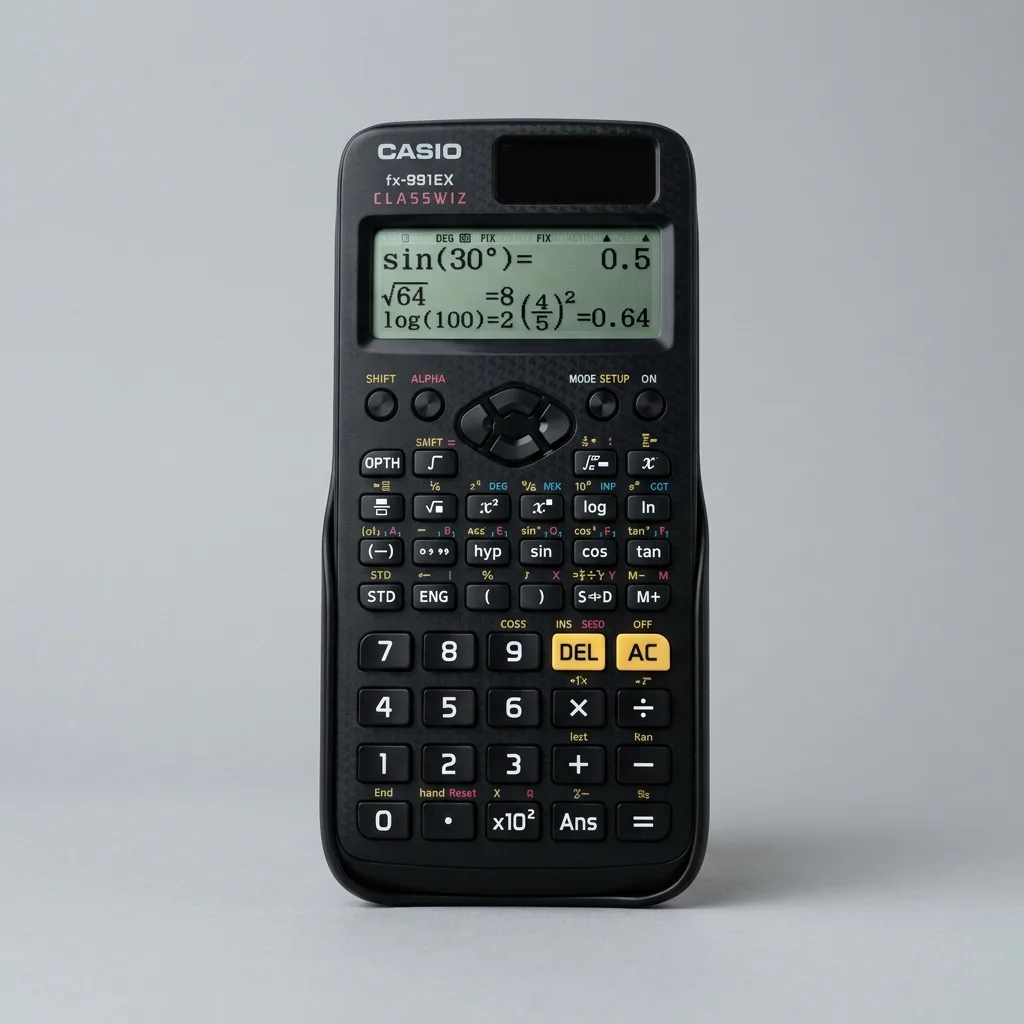
The #1 recommended scientific calculator for board exams, math, and physics.
As an Amazon Associate we earn from qualifying purchases.
Welcome to Class X Mathematics: Real Numbers. This chapter forms a core structural component of the math syllabus, designed to build analytical rigor and key formula models.
Use the detailed subtopic guide below to review standard definitions, key mathematical rules, and study guidelines.
This comprehensive study guide for Real Numbers is designed for Class X students following the CBSE and NCERT Mathematics curriculum. It covers 4 key subtopics including Fundamental Theorem of Arithmetic, Euclid division lemma overview, Rational and Irrational proofs (proving √2, √3, √5 are irrational), and 1 more essential concepts. Whether you are preparing for school examinations, CBSE board exams, or competitive tests, this resource provides everything you need to build a strong conceptual foundation and achieve mastery.
The chapter includes 1 key formulas and equations, 1 fully worked step-by-step example problems, interactive practice exercises across 9 difficulty categories, timed mock quizzes, and downloadable worksheets. Each topic is explained with detailed concept definitions, mathematical representations, and expert study guidelines to help you understand not just the "how" but the "why" behind every formula and method.
Mathematics is a subject that rewards consistent practice and conceptual clarity over rote memorization. As you work through this chapter on Real Numbers, focus on understanding the underlying principles first, then gradually increase problem difficulty. Use the practice sections to identify and strengthen weak areas, and refer to the common mistakes section to avoid the pitfalls that most students encounter.
By the end of studying Real Numbers for Class X, you will have developed proficiency in the following learning outcomes as outlined by the NCERT syllabus:
Verify prime factorization structures using product properties.
Prove irrationality of square root integers using contradiction proofs.
Determine if a rational fraction has terminating decimal expansion.
Before studying Real Numbers, make sure you are comfortable with the following prerequisite concepts. A strong foundation in these areas will help you understand new topics faster and solve problems more confidently:
If any of these prerequisites feel unfamiliar, consider reviewing them first using the Related Chapters section at the bottom of this page. Building a solid base ensures you can tackle Real Numbers with full confidence.
Students often wonder “Where will I use Real Numbersin real life?” The answer is: everywhere. The mathematical concepts you learn in this chapter have practical applications across science, engineering, technology, medicine, finance, and everyday problem-solving. Here are some notable examples:
Engineers use the unique prime factorization theorem (Fundamental Theorem of Arithmetic) in encryption algorithms that secure digital communications.
RSA encryption relies on properties of prime numbers and the difficulty of factoring large numbers — a direct application of number theory.
Musical intervals are based on rational number ratios between frequencies — the octave is 2:1, the perfect fifth is 3:2.
Understanding rational vs irrational numbers helps scientists express measurement precision and handle significant figures correctly.
Understanding the real-world relevance of Real Numbers not only makes learning more engaging but also helps you appreciate how mathematical thinking is a superpower that opens doors in virtually every career path — from engineering and medicine to finance and technology.
Follow these expert study strategies to maximize your understanding and exam performance in this chapter. These tips are specifically tailored for the type of content covered in Real Numbers:
Write out every intermediate step when solving problems. Skipping steps is the most common source of errors in calculation-heavy chapters. Build speed only after achieving consistent accuracy.
After finding your answer, substitute it back into the original equation to verify correctness. This simple habit catches most arithmetic and sign errors before they cost you marks.
Keep a dedicated notebook of mistakes you make during practice. Review it weekly to identify patterns — you will notice the same types of errors recurring and can actively work to eliminate them.
Pro Tip: Consistency beats intensity. Studying Real Numbers for 30 minutes daily is far more effective than cramming for 5 hours before the exam. Use the practice sections below to build muscle memory through regular problem-solving.
Review detailed conceptual explanations, mathematical equations, and guidelines for each subtopic in this chapter:
The Fundamental Theorem of Arithmetic states that every composite number can be expressed (factorized) as a product of prime numbers, and this factorization is unique, apart from the order in which the prime factors occur.
Euclid's Division Lemma states that for any two positive integers a and b, there exist unique integers q (quotient) and r (remainder) satisfying a = bq + r, where the remainder r is non-negative and strictly less than the divisor b.
Proofs of irrationality show that numbers like √2, √3, or √5 cannot be written as a ratio of co-prime integers. These proofs use contradiction: assuming the number is rational (p/q), showing that both p and q must share a common factor (violating co-primality).
A rational number p/q has a terminating decimal expansion if the prime factorization of its denominator q is of the form 2^n * 5^m, where n and m are non-negative integers. Otherwise, it has a non-terminating repeating decimal expansion.
By the end of this chapter, students will be able to master and solve questions on these outcomes:
Verify prime factorization structures using product properties.
Prove irrationality of square root integers using contradiction proofs.
Determine if a rational fraction has terminating decimal expansion.
Every composite number can be uniquely expressed as product of primes.
[From Polynomials] Sum of roots of ax² + bx + c.
[From Polynomials] Product of roots of ax² + bx + c.
Solve trigonometric, exponential, logarithmic, and root functions for standard algebraic values.
Deterministic Mathematical Simulation Engine • Client-Side Computation
Solve trigonometric, exponential, logarithmic, and root functions for standard algebraic values.
| Parameter | Value | Unit |
|---|---|---|
| Value (X) | 45 | — |
| Function | sin | — |
| Metric | Calculated Output |
|---|---|
| Function Output | 0.707 |
MATH SOLVER RUNNING:
 [Inputs] ──► [Mathematical Formula] ──► [Outputs]
  Processed elements successfully.
📚 Level up by completing practice sets.
100% Mastery
No weak areas logged!
Simple algebraic checks with hints and solutions enabled.
Standard curriculum queries matching board exam templates.
Complex math application questions with numeric inputs.
5 mixed questions with a ticking clock to evaluate speed.
Specialized assessment matching the printed worksheets.
Strict 10-question chapter exam. Hints are disabled.
Combines prerequisite concepts and related chapter formulas.
Original questions from previous year CBSE board exams.
High-order logical problems matching Olympiad standards.
Test your math skills with this 5-question chapter mock exam. A live ticking clock will monitor your performance.
Review and solve 213 real Board paper questions from the 20 mock sample sets matching Real Numbers.
If two positive integers p and q can be expressed as p = 18 a2b4 and q = 20 a3b2, where a and b are prime numbers, then LCM (p, q) is :
If ∆PQR ~ ∆ABC; PQ = 6 cm, AB = 8 cm and the perimeter of ∆ABC is 36 cm, then the perimeter of ∆PQR is
ΔABC~ΔPQR. If AM and PN are altitudes of ΔABC and ΔPQR respectively and AB2 : PQ2 = 4 : 9, then AM : PN =
ABCD is a trapezium with AD ∥ BC and AD = 4cm. If the diagonals AC and BD intersect each other at O such that AO/OC = DO/OB =1/2, then BC =
The middle most observation of every data arranged in order is called
Assertion (A): If product of two numbers is 5780 and their HCF is 17, then their LCM is 340 Reason (R): HCF is always a factor of LCM
The length of the minute hand of a clock is 6cm. Find the area swept by it when it moves from 7:05 p.m. to 7:40 p.m.
Prove that √5 is an irrational number.
Three years ago, Rashmi was thrice as old as Nazma. Ten years later, Rashmi will be twice as old as Nazma. How old are Rashmi and Nazma now?
To fill a swimming pool two pipes are used. If the pipe of larger diameter used for 4 hours and the pipe of smaller diameter for 9 hours, only half of the pool can be filled. Find, how long it would take for each pipe to fill the pool separately, if the pipe of smaller diameter takes 10 hours more than the pipe of larger diameter to fill the pool?
When 2120 is expressed as the product of its prime factors we get
The ratio in which x-axis divides the join of (2, -3) and (5, 6) is:
The solution of the following pair of equation is: x - 3y = 2, 3x - y = 14
ABCD is a trapezium with AD ∥ BC and AD = 4cm. If the diagonals AC and BD intersect each other at O such that AO/OC = DO/OB =1/2, then BC =
The LCM of smallest two-digit composite number and smallest composite number is:
Assertion (A): If HCF ( 90, 144) = 18, then LCM (90, 144) = 720 Reason (R): HCF (a, b) x LCM (a, b) = a x b
Assertion (A): The point (0, 4) lies on y-axis. Reason (R): The y co-ordinate of the point on x-axis is zero.
In the given figure below, AD/AE=AC/BD and ∠1=∠2. Show that Δ BAE~ ΔCAD .
Prove that √2 is an irrational number.
A motor boat whose speed is 15 km/hr in still water goes 30 km downstream and comes back in 4 hours 30 minutes. Find the speed of the stream.
State and prove Basic Proportional Theorem.
The solution of the following pair of equation is: x - 3y = 2, 3x - y = 14
108 can be expressed as a product of its primes as ……………..
In the ∆ABC, D and E are points on side AB and AC respectively such that DE || B
What is the positive real root of 64x2 - 1 = 0?
If two positive integers a and b are written as a = x3y2 and b = xy3, where x and y are prime numbers, then the HCF (a, b) is:
Assertion (A): The HCF of two numbers is 9 and their LCM is 2016. If the one number is 54, then the other number is 336. Reason (R): Relation between numbers and their HCF and LCM is product of two numbers a, b = HCF (a, b) × LCM (a, b).
The length of the minute hand of a clock is 14 cm. Find the area swept by the minute hand in 5 minutes.
A part of monthly hostel charges in a college is fixed and the remaining depends on the number of days one has taken food in the mess. When a student ‘A’ takes food for 22 days, he has to pay Rs. 1380 as hostel charges; whereas a student ‘B’, who takes food for 28 days, pays Rs. 1680 as hostel charges. Find the fixed charges and the cost of food per day.
Prove that √5 is an irrational number.
Some students planned a picnic. The total budget for food was Rs. 2,000. But 5 students failed to attend the picnic and thus the cost of food for each member increased by Rs. 20. How many students attended the picnic and how much did each student pay for the food?
Case Study - 3 In the month of April to June 2022, the exports of passenger cars from India increased by 26% in the corresponding quarter of 2021 -22, as per a report. A car manufacturing company planned to produce 1800 cars in 4th year and 2600 cars in 8th year. Assuming that the production increases uniformly by a fixed number every year. Based on the above information
If ∆ABC ~ ∆EDF and ∆ABC is not similar to ∆DEF, then which of the following is not true?
ΔABC~ΔPQR. If AM and PN are altitudes of ΔABC and ΔPQR respectively and AB2: PQ2 = 4: 9, then AM: PN =
If 2sin2 β - cos2 β = 2, then β is:
If two positive integers p and q can be expressed as p = ab2 and q = a3b; a, b being prime numbers, then LCM (p, q) is
The perimeter of a triangle with vertices (0, 4), (0, 0) and (3, 0) is
Assertion: The HCF of two numbers is 9 and their LCM is 2016. If the one number is 54, then the other number is 336. Reason: Relation between numbers and their HCF and LCM is product of two numbers a, b = HCF (a, b) × LCM (a, b).
If sin(A + B) = 1 and cos(A - B) = √3/2, 0°< A + B ≤ 90° and A > B, then find the measures of angles A and B.
The length of the minute hand of a clock is 6cm. Find the area swept by it when it moves from 5:25 pm to 6:00 pm.
In the given figure, AP = 3 cm, AR = 4.5 cm, AQ = 6 cm, AB = 5 cm, AC = 10 cm. Find the length of AD
Given that √5 is irrational, prove that 2 + 3√5 is irrational.
A motor boat whose speed is 18 km/h in still water takes 1 hour more to go 24 km upstream than to return downstream to the same spot. Find the speed of the stream.
The top of a table is shown in the figure given below: On the basis of above information
The ratio in which x-axis divides the join of (2, -3) and (5, 6) is:
In ∆ABC and ∆DEF, ∠B = ∠E, ∠F = ∠C and AB = 3DE. Then, the two triangles are
ABCD is a trapezium with AD ∥ BC and AD = 4cm. If the diagonals AC and BD intersect each other at O such that AO/OC = DO/OB =1/2, then BC =
In the figure, if OA OD B OC O= , then which pair of angles are equal?
The value of ‘a’, if HCF (a, 18) = 2 and LCM (a, 18) = 36, is: (1)
10. The value of ‘a’, if HCF (a, 18) = 2 and LCM (a, 18) = 36, is: (1)
The LCM of smallest two-digit composite number and smallest composite number is:
The solution of the following pair of equation is: x - 3y = 2, 3x - y = 14
A horse is tied to a pole with 28 m long rope. The perimeter of the field where the horse can graze is (Take π = 22/7)
Assertion (A): The number 6n, n being a natural number, ends with the digit 5. Reason (R): The number 9n cannot end with digit 0 for any natural number n.
The length of the minute hand of a clock is 14 cm. Find the area swept by the minute hand in 5 minutes.
Evaluate: 3 cos2 60° sec2 30° - 2 sin2 30° tan2 60°.
In the given figure below, AD/AE=AC/BD and ∠1=∠2. Show that Δ BAE~ ΔCAD .
Prove that √5 is an irrational number.
Some students planned a picnic. The total budget for food was Rs. 2,000. But 5 students failed to attend the picnic and thus the cost of food for each member increased by Rs. 20. How many students attended the picnic and how much did each student pay for the food?
State and prove Basic Proportional Theorem.
Case Study - 3 Ananya saves Rs. 24 during the first month Rs. 30 in the second month and Rs. 36 in the third month. She continues to save in this manner. On the basis of above information
In ΔABC right angled at B, if tanA = √3 , then then cosA cosC - sinAsinC =
If LCM(x, 18) = 36 and HCF(x, 18) = 2, then x is:
What is the positive real root of 64x2 - 1 = 0?
In the figure, if DE || BC, AD = 3 cm, BD = 4 cm and BC = 14 cm, then DE equals :
The ratio of LCM and HCF of the least composite and the least prime numbers is:
Assertion (A): 6n never ends with the digit zero, where n is natural number. Reason (R): Any number ends with digit zero, if its prime factor is of the form 2m × 5n, where m, n are natural numbers.
In the below left figure, two chords AB and CD intersect each other at the point P. Prove that (i) ΔAPC ~ ΔDPB (ii) AP. PB = CP. DP
A part of monthly hostel charges in a college is fixed and the remaining depends on the numb er of days one has taken food in the mess. When a student ‘A’ takes food for 22 days, he has to pay Rs. 1380 as hostel charges; whereas a student ‘B’, who takes food for 28 days, pays Rs. 1680 as hostel charges. Find the fixed charges and the cost of food per day.
Four bells toll at an interval of 8, 12, 15 and 18 seconds respectively. All the four begin to toll together. Find the number of times they toll together in one hour excluding the one at the start.
Two pipes running together can fill a cistern in 1313 hours. If one pipe takes 3 hours more than the other to fill it, find the time in which each pipe would fill the cistern.
The pair of equations x + 2y + 5 = 0 and -3x - 6y + 1 = 0 have
Which of the following relationship is correct ?
7. The distance of the point P (2, 3) from the x-axis is
The sum of exponents of prime factors in the prime-factorisation of 196 is:
A circus artist is climbing a 30 m long rope, which is tightly stretched and tied from the top of a vertical pole to the ground. Find the distance of the pole to the peg in the ground, if the angle made by the rope with the ground level is 30⁰.
The solution of the equations x - y = 2 and x + y = 4 is:
If 1080 = 2x × 3y × 5, then (x - y) is equal to :
Assertion (A): The largest number that divide 70 and125 which leaves remainder 5 and 8 is 13 Reason (R): HCF (65,117) =13
Assertion (A): If two triangles are similar and have an equal area, then they are congruent. Reason (R): Corresponding sides of two triangles are equal, then triangles are congruent.
Find the points on the x-axis which are at a distance of 2√5 from the point (7, -4). How many such points are there?
Solve for x and y: 71x + 37y = 253, 37x + 71y = 287
Prove that 2 + 5√3 is an irrational number, if it is given that √3 is an irrational number.
In the below figure, if ∠1 =∠2 and ΔNSQ = ΔMTR, then prove that ΔPTS ~ ΔPRQ.
A motorboat whose speed in still water is 9 km/h, goes 15km downstream and comes back to the same spot, in a total time of 3 hours 45 minutes. Find the speed of the stream.
HCF of (23 x 32 x 5), (22 x 33 x 52) and (24 x 3 x 53 x 7) is
The least number that is divisible by all the numbers from 1 to 10 (both inclusive) is:
In what ratio does the x-axis divide the join of A(2, -3) and B(5, 6)?
The distance between the points (2, - 1) and (- 1, - 5) is :
Assertion : The HCF of two numbers is 18 and their product is 3072. Then their LCM = 169. Reason : If a, b are two positive integers, then HCF x LCM = a x b.
If the point P(k - 1, 2) is equidistant from the points A(3, k) and B(k, 5), find the values of k.
If 2x + y = 23 and 4x - y = 19, find the values of 5y - 2x and y/x - 2.
Given that √3 is irrational, prove that (2 + √3) is an irrational number.
Out of a group of swans, 7/2 times the square root of the total number of swans are playing on the shore of a tank. Remaining two are playing, with amorous fight, in the water. What is the total number of swans?
The pair of equations x = 2a and y = 3b (a, b ≠ 0) graphically represents straight lines which are :
In the given figure, if M and N are points on the sides OP and OS respectively of ∆OPS, such that MN || PS, then the length of OP is :
The point on x-axis which is equidistant from the points (5, - 3) and (4, 2) is :
The 7th term from the end of the A.P. : - 8, - 5, - 2, ..., 49 is :
After an examination, a teacher wants to know the marks obtained by maximum number of the students in her class. She requires to calculate ................. of marks.
Two positive integers m and n are expressed as m = p5q2 and n = p3q4, where p and q are prime numbers. The LCM of m and n is :
XOYZ is a rectangle with vertices X(-3, 0), O(0, 0), Y(0, 4) and Z(x, y). The length of its each diagonal is
Which term of the A.P. -29, -26, -23, ..., 61 is 16?
If sin(A + B) = 1 and cos(A - B) = √3/2, 0°< A + B ≤ 90° and A > B, then find the measures of angles A and B.
Given that √3 is irrational, prove that 5 + 2√3 is irrational.
Find the type of triangle ABC formed whose vertices are A(1, 0), B(-5, 0) and C(-2, 5).
If Nidhi were 7 years younger than what she actually is, then the square of her age (in years) would be 1 more than 5 times her actual age. What is her present age?
(a) Using graphical method, solve the following system of equations: 3x + y + 4 = 0 and 3x - y + 2 = 0
In a survey on holidays, 120 people were asked to state which type of transport they used on their last holiday. The following pie chart shows the results of the survey. Observe the pie chart and
Let a and b be two positive integers such that a = p3q4 and b = p2q3 , where p and q are prime numbers. If HCF(a, b) = pmqn and LCM(a, b) = prqs, then (m + n)(r + s) =
If the distance between the points (3, -5) and (x, -5) is 15 units, then the values of x are :
In the given figure below, AD/AE=AC/BD and ∠1=∠2. Show that Δ BAE~ ΔCAD .
Can the number (15)n, n being a natural number, end with the digit 0? Give reasons.
Prove that √5 is an irrational number.
A backyard is in the shape of a triangle ABC with right angle at B. AB = 7 m and BC 15 m. A circular pit was dug inside it such that it touches the walls AC, BC and AB at P, Q and R respectively such that AP = x m. Based on the above information,
If 2 32 50p = , then p is a/an
What is the ratio of their radii ?
The distance of the point (-1, 7) from x-axis is:
The distance of the point (-6, 8) from origin is:
In ∆ABC, PQ || B
Two number are in the ratio 2 : 3 and their LCM is 180. What is the HCF of these numbers?
How many terms are there in an A.P. whose first and fifth terms are -14 and 2, respectively and the last term is 62. OR Which term of the A.P.: 65, 61, 57, 53, .................. is the first negative term?
Find the HCF and LCM of 26, 65 and 117, using prime factorisation.
D is a point on the side BC of a triangle ABC such that ∠ADC = ∠BAC, prove that CA2 = CB. CD
Two schools 'P' and 'Q' decided to award prizes to their students for two games of Hockey Rs. x per student and Cricket Rs. y per student. School 'P' decided to award a total of Rs. 9,500 for the two games to 5 and 4 students respectively; while school 'Q' decided to award Rs. 7,370 for the two games to 4 and 3 students respectively. Based on the above information,
In a formula racing competition, the time taken by two racing cars A and B to complete 1 round of the track is 30 minutes and p minutes respectively. If the cars meet again at the starting point for the first time after 90 minutes and the HCF (30, p) = 15, then the value of p is
For the following distribution: Marks Below 10 Below 20 Below 30 Below 40 Below 50 Below 60 No. of Students 3 12 27 57 75 80 the modal class is
In ΔABC right angled at B, if cotC = √3 , then then cosAsinC + sinAcosC =
In ABC, DE || AB, If CD = 3 cm, EC = 4 cm, BE = 6 cm, then DA is equal to
If in two triangles, DEF and PQR, ∠D=∠Q and ∠R=∠Ethen which of the following is not true?
The pair of equations x + 2y + 5 = 0 and -3x - 6y + 1 = 0 have
If p and q are positive integers such that p = a3b2 and q = a2b, where ‘a’ and ‘b’ are prime numbers, then the LCM ( p, q) is …..
The ratio in which x-axis divides the join of (2, -3) and (5, 6) is:
Assertion (A): The length of the minute hand of a clock is 7 cm. Then the area swept by the minute hand in 5 minute is 77/6 cm2. Reason (R): The length of an arc of a sector of angle q and radius r is given by 0 2360l r θ π= ×
Find the point on y-axis which is equidistant from the points (5, - 2) and (-3, 2).
If its 25th term is three times its 8th term, find the AP.
Prove that (sinA + cosecA)2 + (cosA + secA)2 = 7 + tan2A + cot2A
A person on tour has Rs.360 for his expenses. If he extends his tour for 4 days, he has to cut down his daily expenses by Rs.3. Find the original duration of the tour.
State and prove Basic Proportional Theorem.
If two positive integers a and b are written as a = x3y2 and b = xy3; x, y are prime numbers, then HCF (a, b) is
In ∆ABC and ∆DEF, ∠B = ∠E, ∠F = ∠C and AB = 3DE. Then, the two triangles are
In the figure, if OA OD B OC O= , then which pair of angles are equal?
If the distance between the points (2, -2) and (-1, x) is 5, one of the values of x is
The value of ‘a’, if HCF (a, 18) = 2 and LCM (a, 18) = 36, is: (1)
Assertion (A): If product of two numbers is 5780 and their HCF is 17, then their LCM is 340 Reason (R) : HCF is always a factor of LCM
In the below left figure, two chords AB and CD intersect each other at the point P. Prove that (i) ΔAPC ~ ΔDPB (ii) AP. PB = CP. DP
Evaluate: 3 cos2 60° sec2 30° - 2 sin2 30° tan2 60°.
If the perimeter of a protractor is 72 cm, calculate its area. (Use π = 22 7 )
Two numbers are in the ratio of 1 : 3. If 5 is added to both the numbers, the ratio becomes 1 : 2. Find the numbers.
Given that √3 is irrational, prove that 2 + 5√3 is irrational. So √3 = 2 5 p q q - …(i) RHS of equation (i) is rational.
Two pipes running together can fill a cistern in 3 1 13 hours. If one pipe takes 3 hours more than the other to fill it, find the time in which each pipe would fill the cistern.
Case Study-3 Mohan is an auto driver. His autorickshaw was too old and he had to spend a lot of money on repair and maintenance every now and then. One day he got to know about the EV scheme of the Government of India where he can not only get a good exchange bonus but also avail heavy discounts on the purchase of an electric vehicle. So, he took a loan of 1,18,000 from a reputed bank and purchased a new autorickshaw. Mohan repays his total loan of 118000 rupees by paying every month starting with the first instalment of 1000 rupees. (i) If he increases the instalment by 100 rupees every month, then what amount will be paid by him in the 30th instalment? [1] (ii) If he increases the instalment by 100 rupees every month, then what amount of loan does he still have to pay after 30th instalment? [2] OR (ii)If he increases the instalment by 200 rupees every month, then what amount would he pay in 40th instalment? [2] (iii) If he increases the instalment by 100 rupees every month, then what amount will be paid by him in the 100th instalment
If two positive integers p and q can be expressed as p = ab3 and q = a3 b; a, b being prime numbers, then HCF (p, q) is
If triangles ABC and DEF are similar and AB=4 cm, DE=6 cm, EF=9 cm and FD=12 cm, the perimeter of triangle ABC is:
4 tan2 A - 4 sec2 A is equal to:
Which of the following equations has 2 as a root?
In the below figure, AD = 3 cm, AE = 5 cm, BD = 4 cm, CE = 4 cm, CF = 2 cm, BF = 2.5 cm, then
The LCM of smallest two digit composite number and smallest composite number is:
Assertion (A): The number 6n, n being a natural number, ends with the digit 5. Reason (R): The number 9n cannot end with digit 0 for any natural number n.
Assertion (A): The point (3, 0) lies on x -axis. Reason (R): The x co-ordinate on the point on y -axis is zero.
A man wished to give Rs. 12 to each person and found that he fell short of Rs. 6 when he wanted to give to all the persons present. He, therefore, distributed Rs. 9 to each person and found that Rs. 9 were left over. How much money did he have and how many persons were there?
Given that √3 is irrational, prove that 5 + 2√3 is irrational. This contradiction has arisen due to our wrong assumption that 5 + 2√3 is rational So, 5 + 2√3 is irrational. SECTION - D Questions 32 to 35 carry 5 marks each.
A train travels at a certain average speed for a distance of 63 km and then travels at a distance of 72 km at an average speed of 6 km/hr more than its original speed. If it takes 3 hours to complete tota l journey, what is the original average speed?
Anita’s mother start a new shoe shop. To display the shoes, she put 3 pairs of shoes in 1st row, 5 pairs in 2nd row, 7 pairs in 3rd row and so on. On the basis of above information,
If the HCF of two positive integers is 3 and their product is 9, what is their LCM?
If two positive integers a and b are written as a = p^3 q^4 and b = p^2 q^3, where p and q are prime numbers, then LCM(a, b) is:
Assertion (A): The HCF of two numbers is 5 and their LCM is 200. Product of numbers is 1000. Reason (R): For any two positive integers, HCF * LCM = Product of numbers.
Prove that √2 - √5 is an irrational number.
If two positive integers a and b are written as a = x^3 y^2 and b = x y^3, where x, y are prime numbers, then HCF(a, b) is:
Assertion (A): The polynomial p(x) = x^2 + 3x + 2 has real zeroes. Reason (R): A quadratic polynomial ax^2 + bx + c has real zeroes if b^2 - 4ac ≥ 0.
Explain why 2 * 5 * 7 * 11 + 11 * 13 is a composite number.
Prove that √5 is an irrational number.
If the diagonals of a quadrilateral divide each other proportionally, then it is a:
In ∆ABC, DE || BC(as shown in the figure). If AD = 2cm, BD = 3cm, BC = 7.5cm, then the length of DE(in cm) is:
The HCF and the LCM of 12, 21, 15 respectively are
A pair of irrational numbers whose product is a rational number is:
If the sum of LCM and HCF of two numbers is 1260 and their LCM is 900 more than their HCF, then the product of two numbers is
If sin(A - B) = 1 2 , cos(A + B) = 1 2 , 00< A + B ≤900 , A > B. Find A and B.
(a) Find a relation between x and y such that the point P(x, y) is equidistant from the points A(7,1) and B(3,5).
In the figure, QR QT QS PR= and ∠1 = ∠2, Show that ∆PQS ∼ ∆TQR.
A train, travelling at a uniform speed for 360 km, would have taken 48 minutes less to travel the same distance if its speed were 5 km/h more. Find the original speed of the train.
Mutual Fund : A mutual fund is a type of investment vehicle that pools money from multiple investors to invest in securities like stocks, bonds or other securities. Mutual funds are operated by professional money managers, who allocate the fund’s assets and attempt to produce capital gains or income for the fund’s investors. Net Asset Value (NAV) represents a fund’s per share market value. It is the price at which the investors buy fund shares from a fund company and sell them to a fund company. The following table shows the Net Asset Value (NAV) per unit of mutual fund of ICICI mutual funds: NAV (in Rs.) 0 - 5 5 - 10 10 - 15 15 - 20 20 - 25 Number of mutual funds 13 16 22 18 11 Based on the above information,
A stable owner has four horses. He usually tie these horses with 7 m long rope to pegs at each corner of a square shaped grass field of 20 m length, to graze in his farm. But tying with rope sometimes results in injuries to his horses, so he decided to build fence around the area so that each horse can graze. Based on the above,
Teaching Mathematics through activities is a powerful approach that enhances students' understanding and engagement. Keeping this in mind, Ms. Mukta planned a prime number game for class 5 students. She announces the number 2 in her class and asked the first student to multipl y it by a prime number and then pass it to second student. Second student also multiplied it by a prime number and passed it to third student. In this way by multiplying to a prime number, the last student got 173250. Now, Mukta asked some questions as given below to the students : (i) What is the least prime number used by students? (1) (ii) (a) How many students are in the class? (2) OR (b) What is the highest prime number used by students? (2) (iii) Which prime number has been used maximum times ? (1)
For the following distribution: Marks Below 10 Below 20 Below 30 Below 40 Below 50 Below 60 No. of students 3 12 27 57 75 80 the modal class is
If x = 2sin2θ and y = 2cos2θ + 1 then x + y is:
If the LCM of a and 18 is 36 and the HCF of a and 18 is 2, then a =
The point on the x-axis which is equidistant from (- 4, 0) and (10, 0) is:
(a) In the given figure, PQ || RS. Prove that OP × OR = OQ × OS.
Given that HCF (306, 1314) = 18, find LCM of (306, 1314).
Show that 5 + 2√7 is an irrational number, where √7 is given to be an irrational number.
(a) If Ritu were younger by 5 years than what she really is, then the square of her age would have been 11 more than five times her present age. What is her present age?
A contractor plans to install two slides for the children to play in a park. For the children below the age of 6 years, he prefers to have a slide whose top is at a height of 2·0 m and is inclined at an angle of 30° to the ground, whereas for older children, he wants to have a steep slide at a height o f 4·0 m and inclined at an angle of 60° to the ground. What would be the length of the slide in each case ?
A manufacturer of TV sets produced 720 TV sets in the fourth year and 880 TV sets in the eighth year. Assuming that the production increases uniformly by a fixed number every year, find the production in the tenth year and the total production in the first seven years.
If ∆ABC ~ ∆EDF and ∆ABC is not similar to ∆DEF, then which of the following is not true?
Given HCF(2520, 6600) = 40, LCM(2520, 6600) = 252 × k, then the value of k is:
If cosθ = √3/2 and sinϕ = 1/2, then tan(θ + ϕ) is:
Consider the following distribution: Marks obtained Number of students More than or equal to 0 63 More than or equal to 10 58 More than or equal to 20 55 More than or equal to 30 51 More than or equal to 40 48 More than or equal to 50 42 the frequency of the class 30-40 is
Assertion (A): For any two positive integers a and b, HCF(a, b) x LCM(a, b) = a x b Reason (R): The HCF of two numbers is 5 and their product is 150. Then their LCM is 40.
In the given figure, EA/EC = EB/ED, prove that ∆EAB ~ ∆ECD
4 Bells toll together at 9.00 am. They toll after 7, 8, 11 and 12 seconds respectively. How many times will they toll together again in the next 3 hours?
Deepankar bought 3 notebooks and 2 pens for Rs. 80 and his friend Suryansh bought 4 notebooks and 3 pens for Rs. 110 from the school bookshop. Based on the above information,
In the ∆ABC, D and E are points on side AB and AC respectively such that DE || B
The LCM of two numbers is 14 times their HCF. The sum of LCM and HCF is 600. If one number is 280, then the other number is
ABCD is a trapezium with AD ∥ BC and AD = 4cm. If the diagonals AC and BD intersect each other at O such that AO/OC = DO/OB =1/2, then BC =
When 2120 is expressed as the product of its prime factors we get
The number of revolutions made by a circular wheel of radius 0.7 m in rolling a distance of 176 m is
If ΔABC ~ ΔEDF and ΔABC is not similar to ΔDEF, then which of the following is not true?
Assertion (A): The number 6n never end with digit 0 for any natural number n.. Reason (R): The number 9n never end with digit 0 for any natural number n.
In figure, ABCD is a rectangle. Find the values of x and y.
A part of monthly hostel charges in a college is fixed and the remaining depends on the number of days one has taken food in the mess. When a student ‘A’ takes food for 22 days, he has to pay Rs. 1380 as hostel charges; whereas a student ‘B’, who takes foo d for 28 days, pays Rs. 1680 as hostel charges. Find the fixed charges and the cost of food per day.
Prove that √5 is an irrational number.
Two water taps together can fill a tank in 39 8 hours. The tap of larger diameter takes 10 hours less than the smaller one to fill the tank separately. Find the time in which each tap can separately fill the tank.
Raj is an electrician in a village. One day power was not there in entire village and villagers called Raj to repair the fault. After thorough inspection he found an electric fault in one of the electric pole of height 5 m and he has to repair it. He needs to reach a point 1.3m below the top of the pole to undertake the repair work. Based on the above information
Recognizing and eliminating common errors is a key step to scoring high marks in school and board exams:
Multiplying negative integers and writing a negative output, or adding numbers with different signs incorrectly.
Treating a number divided by zero as zero, rather than stating it is undefined.
Simply adding numerators and denominators directly (e.g. 1/2 + 2/3 = 3/5 is WRONG). Always find the Lowest Common Multiple of the denominators.
Understand differences between Whole numbers, Integers (negative & positive), Rational numbers (fractions), and Irrational roots.
Multiply or divide the numerator and denominator by the same number to maintain proportionality.
The reciprocal of a fraction a/b is b/a. Multiplying them always yields 1.
Ensure all prerequisite concepts are fully understood before working on advanced calculations.
Always check equations step-by-step to avoid simple sign and arithmetic errors.
Resolve equations using alternative methods (e.g., check quadratic roots by plugging them back into ax² + bx + c), verify decimals using scientific solvers, and review step-by-step worked calculations.
Trigonometry is used in architecture, mechanics and navigation. Quadratic equations model rocket trajectories and profit boundaries. Basic arithmetic and fractions are applied in accounting, budgeting and lab chemistry.
Check out these related chapters and pre-requisites to strengthen your analytical foundation:
[Adjacent Chapter] Interpret zeroes visually as graph x-intercepts.
Determine if a system of two equations has 0, 1, or infinite solutions.
Translate real-world word problems into second-degree quadratic equations.
Use these related calculator solvers to verify variables and double check homework steps:
Solve trigonometric, exponential, logarithmic, and root functions for standard algebraic values.
Perform arithmetic operations on fractions: add, subtract, multiply, and divide two fractions. Simplifies the results dynamically and provides decimal equivalencies.
Select any key syllabus topic below to open its detailed learning guide, worked models, and study guidelines.
Learn the easiest ways to simplify fractions. Master finding the Greatest Common Divisor (GCD) and reducing fractions to their simplest form with worked examples.
Demystify mathematical sequences. Learn to identify arithmetic and geometric progressions, calculate common differences/ratios, and find the nth term.
Learn the math behind ratios and proportions. Master scaling values, dividing amounts by ratios, and solving proportions using cross-multiplication.
Generate and print a beautiful chapter worksheet complete with key equations, problems, and dedicated writing spaces.
1. The length of the minute hand of a clock is 6cm. Find the area swept by it when it moves from 7:05 p.m. to 7:40 p.m.
2. Prove that √5 is an irrational number.
3. Three years ago, Rashmi was thrice as old as Nazma. Ten years later, Rashmi will be twice as old as Nazma. How old are Rashmi and Nazma now?
4. To fill a swimming pool two pipes are used. If the pipe of larger diameter used for 4 hours and the pipe of smaller diameter for 9 hours, only half of the pool can be filled. Find, how long it would take for each pipe to fill the pool separately, if the pipe of smaller diameter takes 10 hours more than the pipe of larger diameter to fill the pool?
5. In the given figure below, AD/AE=AC/BD and ∠1=∠2. Show that Δ BAE~ ΔCAD .