Loading NexProTools...
Preparing interactive calculation engine
Preparing interactive calculation engine
Standard NCERT & CBSE aligned study curriculum. Master concepts, track accuracy, revise weak areas, and challenge yourself with 9 customized practice modes.
Syllabus Sections
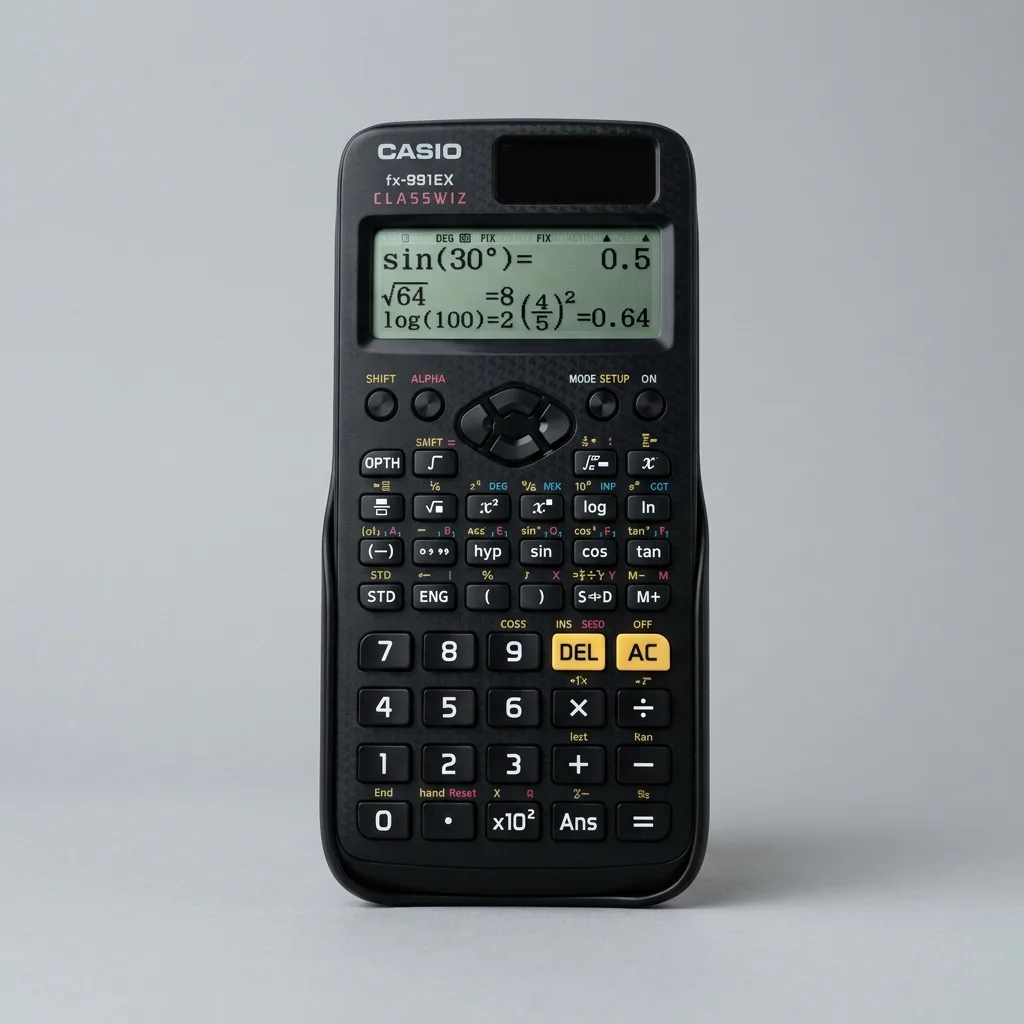
The #1 recommended scientific calculator for board exams, math, and physics.
As an Amazon Associate we earn from qualifying purchases.
Welcome to Class X Mathematics: Introduction to Trigonometry. This chapter forms a core structural component of the math syllabus, designed to build analytical rigor and key formula models.
Use the detailed subtopic guide below to review standard definitions, key mathematical rules, and study guidelines.
This comprehensive study guide for Introduction to Trigonometry is designed for Class X students following the CBSE and NCERT Mathematics curriculum. It covers 4 key subtopics including Trigonometric ratios of acute angles, Trigonometric values of specific angles (0, 30, 45, 60, 90), Ratios of complementary angles, and 1 more essential concepts. Whether you are preparing for school examinations, CBSE board exams, or competitive tests, this resource provides everything you need to build a strong conceptual foundation and achieve mastery.
The chapter includes 2 key formulas and equations, 1 fully worked step-by-step example problems, interactive practice exercises across 9 difficulty categories, timed mock quizzes, and downloadable worksheets. Each topic is explained with detailed concept definitions, mathematical representations, and expert study guidelines to help you understand not just the "how" but the "why" behind every formula and method.
Mathematics is a subject that rewards consistent practice and conceptual clarity over rote memorization. As you work through this chapter on Introduction to Trigonometry, focus on understanding the underlying principles first, then gradually increase problem difficulty. Use the practice sections to identify and strengthen weak areas, and refer to the common mistakes section to avoid the pitfalls that most students encounter.
By the end of studying Introduction to Trigonometry for Class X, you will have developed proficiency in the following learning outcomes as outlined by the NCERT syllabus:
State exact trig values for standard angles.
Prove basic trigonometric equalities.
Solve right-angled triangle missing values using trig ratios.
Before studying Introduction to Trigonometry, make sure you are comfortable with the following prerequisite concepts. A strong foundation in these areas will help you understand new topics faster and solve problems more confidently:
If any of these prerequisites feel unfamiliar, consider reviewing them first using the Related Chapters section at the bottom of this page. Building a solid base ensures you can tackle Introduction to Trigonometry with full confidence.
Students often wonder “Where will I use Introduction to Trigonometryin real life?” The answer is: everywhere. The mathematical concepts you learn in this chapter have practical applications across science, engineering, technology, medicine, finance, and everyday problem-solving. Here are some notable examples:
Surveyors calculate the height of mountains, buildings, and towers using trigonometric ratios and angle measurements from the ground.
Audio engineers model sound waves as sine functions to design speakers, concert halls, and noise-cancellation headphones.
Engineers calculate the optimal angle for satellite dish alignment using trigonometric principles for clear signal reception.
CT scanners use trigonometric reconstruction algorithms to create detailed cross-sectional images of the human body.
Understanding the real-world relevance of Introduction to Trigonometry not only makes learning more engaging but also helps you appreciate how mathematical thinking is a superpower that opens doors in virtually every career path — from engineering and medicine to finance and technology.
Follow these expert study strategies to maximize your understanding and exam performance in this chapter. These tips are specifically tailored for the type of content covered in Introduction to Trigonometry:
Create a table of sin, cos, and tan values for 0°, 30°, 45°, 60°, and 90° and practice until you can recall them instantly. These values appear in almost every trigonometry problem.
Remember "All Students Take Coffee" — All trig functions are positive in Q1, only Sine in Q2, only Tangent in Q3, only Cosine in Q4. This prevents sign errors in angle calculations.
Trigonometric identity proofs require a different skill set from numerical problems. Practice them separately, always working from the more complex side toward the simpler side.
Pro Tip: Consistency beats intensity. Studying Introduction to Trigonometry for 30 minutes daily is far more effective than cramming for 5 hours before the exam. Use the practice sections below to build muscle memory through regular problem-solving.
Review detailed conceptual explanations, mathematical equations, and guidelines for each subtopic in this chapter:
Trigonometric ratios express the relationship between the acute angles of a right-angled triangle and the ratios of its side lengths. The six basic ratios are Sine, Cosine, Tangent, Cosecant, Secant, and Cotangent.
Standard trigonometric values are derived from special right-angled triangles (45°-45°-90° and 30°-60°-90°). These values are highly used in mathematical evaluations and physics.
Complementary angles are angles whose sum is 90 degrees. Trigonometric functions of complementary angles show co-function relationships: sine changes to cosine, tangent to cotangent, and secant to cosecant.
Trigonometric identities are equations involving trigonometric functions that are true for all values of the variables. The three Pythagorean identities are fundamental to algebraic trigonometry.
By the end of this chapter, students will be able to master and solve questions on these outcomes:
State exact trig values for standard angles.
Prove basic trigonometric equalities.
Solve right-angled triangle missing values using trig ratios.
Core trigonometric Pythagorean relationship.
Ratio of sine to cosine functions.
[From Coordinate Geometry] Euclidean distance between two coordinate points.
[From Coordinate Geometry] Coordinates of point dividing line segment in ratio m:n.
[From Some Applications of Trigonometry] Calculates perpendicular height using base distance d and elevation angle θ.
Solve trigonometric, exponential, logarithmic, and root functions for standard algebraic values.
Deterministic Mathematical Simulation Engine • Client-Side Computation
Solve trigonometric, exponential, logarithmic, and root functions for standard algebraic values.
| Parameter | Value | Unit |
|---|---|---|
| Value (X) | 45 | — |
| Function | sin | — |
| Metric | Calculated Output |
|---|---|
| Function Output | 0.707 |
MATH SOLVER RUNNING:
 [Inputs] ──► [Mathematical Formula] ──► [Outputs]
  Processed elements successfully.
📚 Level up by completing practice sets.
100% Mastery
No weak areas logged!
Simple algebraic checks with hints and solutions enabled.
Standard curriculum queries matching board exam templates.
Complex math application questions with numeric inputs.
5 mixed questions with a ticking clock to evaluate speed.
Specialized assessment matching the printed worksheets.
Strict 10-question chapter exam. Hints are disabled.
Combines prerequisite concepts and related chapter formulas.
Original questions from previous year CBSE board exams.
High-order logical problems matching Olympiad standards.
Test your math skills with this 5-question chapter mock exam. A live ticking clock will monitor your performance.
Chapter: Introduction to Trigonometry
Chapter: Coordinate Geometry
Chapter: Some Applications of Trigonometry
Review and solve 93 real Board paper questions from the 20 mock sample sets matching Introduction to Trigonometry.
If x tan 60°cos 60°= sin60°cot 60°, then x =
sec θ when expressed in terms of cot θ, is equal to:
For some data xl, x2, …….. xn with respective frequencies f1, f2, ..... fn, the value of 1 ( ) n i if x x -∑ is equal to:
If cos (α + β) = 0, then value of cos 2 α β+( ) ( )( ) is equal to:
Evaluate: 0 0 02 2 cos 45 sin 30 2 3 cos30+
In the given figure, ABC is a triangle in which DE||BC. If AD = x, DB = x - 2, AE = x + 2 and EC = x - 1, then find the value of x.
Prove that: tan cot 1 sec cos1 cot 1 tan ecθ θ θ θθ θ+ = +- -
If cosec A = 13/12, then the value of 2sin 3cos 4sin 9cos A A A A - -
If sin 2A = 1 2 tan² 45° where A is an acute angle, then the value of A is
If 3 sin θ - cos θ = 0 and 0° < θ < 90°, find the value of θ.
If tan (A + B) = 3 and tan (A - B) = 1 3 ; 0° < A+B ≤ 90°; A > B, find A and B.
In ΔABC, right angled at B, AB = 5 cm and sin C = 1/2. Determine the length of side A
In the given figure, if AB = 14 cm, then the value of tan B is:
If the distance between the points (4,p) and (1,0) is 5, then value of p is
In the given figure, ∆ABC ~ ∆QPR. If AC = 6 cm, BC = 5 cm, QR = 3 cm and PR = x; then the value of x is:
If x = a cos θ and y = b sin θ, then the value of b2x2 + a2y2 is
Assertion (A): The value of y is 3, if the distance between the points P(2, -3) and Q(10, y) is 10. Reason (R): Distance between two points is given by 2 2 2 1 2 1( ) ( )x x y y- + -
Simplify: 2 2 2 2 tan cot 1 tan 1 cot θ θ θ θ++ +
If sec θ + tan θ = p, prove that sin θ = 2 2 1 1 p p - + .
In ABC right angled at B, sin A = 7 25 , then the value of cos C is ………….
If 5 tan θ = 4, then the value of 5sin 3cos 5sin 2cos θ θ θ θ - + is
Assertion (A): The value of y is 3, if the distance between the points P(2, -3) and Q(10, y) is 10. Reason (R): Distance between two points is given by 2 2 2 1 2 1( ) ( )x x y y- + -
If cosec A = 13/12, then the value of 2sin 3cos 4sin 9cos A A A A - -
If tan θ = 1, then the value of sec θ + cosec θ is:
Given that sin α = 1/2 and cos β = 1/2, then the value of (β - α) is
Assertion (A): The value of y is 3, if the distance between the points P(2, -3) and Q(10, y) is 10. Reason (R): Distance between two points is given by 2 2 2 1 2 1( ) ( )x x y y- + -
Prove that: 2 2cos sin 1 sin cos1 tan 1 cot θ θ θ θθ θ+ = +- -
In the ∆ABC, DE ∥ BC and AD = 3x - 2, AE = 5x - 4, BD = 7x - 5, CE = 5x - 3, then find the value of x
If the mean of the following distribution is 2.6, then the value of y is Variable (x) 1 2 3 4 5 Frequency 4 5 y 1 2
The value of k for which the lines 5x + 7y = 3 and 15x + 21y = k coincide is:
If 5 tan θ = 4, then the value of 5sin 3cos 5sin 2 cos θ θ θ θ - + is
If 217x + 131y = 913, 131x + 217y = 827, then find the value of x and y
If sin (A + B) = √3/2 and sin (A - B) = 1 2 , 0 ≤ A + B ≤ 90° and A > B, then find A and B.
Prove that: sin cos 1 sec tansin cos 1 θ θ θ θθ θ - + = ++ -
If C(1, -1) is the mid-point of the line segment AB joining points A(4, x) and B(- 2, 4), then value of x is :
If one root of equation 4x2 - 2x+k-4=0 is reciprocal of the other. The value of k is:
In ∆ ABC, right-angled at B, AC = 25 cm, BC = 7 cm. The value of tan C is:
Prove that: 2 2 2 2 1 sin(tan sec ) (tan sec ) 2 1 sin AA A A A A ( ) ++ + - = ( ) -( )
2 2 1 1 tan sinθ θ ( ) -( )( ) is equal to :
If the distance between the points A(2, -2) and B(-1, x) is equal to 5, then the value of x is:
Prove that (cosec A - sin A)(sec A - cos A)(tan A + cot A) = 1
If sinθ + cosθ = √2, then tanθ + cot θ =
If value of each observation in a data is increased by 2, then median of the new data
Assertion (A): If sin A = 1 3 (0° < A < 90°) , then the value of cos A is 2 2 3 Reason (R): For every angle θ, sin²θ + cos²θ = 1.
Prove that: 3 3 2 2 tan cot sec cos 2sin cos1 tan 1 cot ecθ θ θ θ θ θθ θ+ = -+ +
The value of 2 2 1sin 1 tanθ θ ( ) +( ) +( ) is :
If 5 tanβ = 4, then 5sin 2 cos 5sin 2cos β β β β - =+
If 49x + 51y = 499, 51x + 49y = 501, then find the value of x and y
(a) If cos (A + B) = 1 2 and tan (A - B) = 1 3 , where 0 ≤ A + B ≤ 90°, then find the value of sec (2A - 3B).
Prove that: 2 2 2 2 1 tan (1 tan ) 1 cot (1 cot ) A A A A ( ) + - =( ) + -( )
Find the ratio in which the point 8 ,5 y( ) ( )( ) divides the line segment joining the points (1, 2) and (2, 3). Also, find the value of y.
In the given figure, ∆ABC ~ ∆QPR. If AC = 6 cm, BC = 5 cm, QR = 3 cm and PR = x; then the value of x is:
2 2 2 cos 1 sin sin θ θ θ- , in simplified form is:
Evaluate: 2 0 2 0 2 0 2 0 2 0 5cos 60 4sec 30 tan 45 sin 30 cos 30 + - +
Prove that: 3 3 sin 2sin tan2cos cos A A AA A - =-
The monthly expenditure on milk in 200 families of a Housing Society is given below: Monthly Expenditure (in Rs.) 1000 - 1500 1500 - 2000 2000 - 2500 2500 - 3000 3000 - 3500 3500 - 4000 4000 - 4500 4500 - 5000 Number of families 24 40 33 x 30 22 16 7 Find the value of x and also, find the median and mean expenditure on milk.
If is an acute angle and tan + cot = 2, then the value of sin3 + cos3 is
Assertion (A): If x = 2 sin2θ and y = 2 cos2θ + 1 then the value of x + y = 3. Reason (R): For any value of θ, sin2θ + cos2θ = 1
For what value of k, the following system of equations have infinite solutions: 2x - 3y = 7, (k + 2)x - (2k + 1)y = 3 (2k - 1)?
The value of (sin 45° + cos 45°) is
If tan θ = 1, then the value of sec θ + cosec θ is:
If the mean of the following distribution is 2.6, then the value of y is Variable (x) 1 2 3 4 5 Frequency 4 5 y 1 2
Assertion (A): The value of y is 3, if the distance between the points P(2, -3) and Q(10, y) is 10. Reason (R): Distance between two points is given by 2 2 2 1 2 1( ) ( )x x y y- + -
If tan a bθ = , prove that 2 2 2 2 sin cos sin cos a b a b a b a b θ θ θ θ - - =+ +
The mean and median of a distribution are 14 and 15, respectively. The value of the mode is:
If for some angle θ, cot 2θ = 1 3 , then the value of cos3θ, where 3θ ≤ 90⁰, is
In ∆ABC, right-angled at C, if tan A=1, then the value of 2sin A cos A is
If the distance between the points (x, -1) and (3, 2) is 5, then the value of x is
In ABC, DE || AB. If AD = 2x, DC = x + 3 , BE = 2x - 1 and CE = x, then find the value of ‘x’ ⇒ 2x2 + 6x - x - 3 = 2x2 ⇒ 5x - 3 = 0 ⇒ x =
If sin (A + B) = 1 and sin (A - B) = , 0 ≤ A + B ≤ 90° and A > B, then find A and B.
Prove that sin cos 1 1 cos sin 1 sec tan θ θ θ θ θ θ - + =+ - -
If sin(A + B) = 1 and cos(A - B) = √3/2, where 0° < A + B ≤ 90° and A > B, find the values of A and B.
If sin θ + cos θ = √3, prove that tan θ + cot θ = 1.
If cos θ + cos2 θ = 1, the value of sin2 θ + sin4 θ is :
If cos A = 4/5, then the value of tan A is
(a) If 2x + y = 13 and 4x - y = 17, find the value of (x - y).
Prove that cos 1 sin 2sec1 sin cos A A AA A ++ =+
If ½ is a root of the equation x2 + kx - 5/4 = 0, then the value of k is
In the given figure, if ∆ABC ~ ∆QPR, then the value of x is :
Evaluate: sin 30° cos 60° + cos 30° sin 60° - cot 45°
If cosecθ + cotθ = p, then prove that 2 2 1cos 1 p pθ -= +
In the figure given below, AD = 4 cm, BD = 3 cm and CB = 12 cm, then cot θ equals :
If the distance between the points A(2, -2) and B(-1, x) is equal to 5, then the value of x is:
Evaluate: 0 0 0 0 cos 45 sin 60 sec30 cos 30ec + +
Prove that: 3 3 sin 2sin tan2cos cos θ θ θθ θ - =-
Tower Bridge is a Grade I listed combined bascule and suspension bridge in London, built between 1886 and 1894, designed by Horace Jones and engineered by John Wolfe Barry. The bridge is 800 feet (240 m) in length and consists of two bridge towers connected at the upper level by two horizontal walkways, and a central pair of bascules that can open to allow shipping. In this bridge, two towers of equal heights are standing opposite each other on either side of the road, which is 80 m wide. During summer holidays, Neeta visited the tower bridge. She stood at some point on the road between these towers. From that point between the towers on the road, the angles of elevation of the top of the towers was 60° and 30° respectively. (i) Find the distances of the point from the base of the towers where Neeta was standing while measuring the height. [2] (ii) Neeta used some applications of trigonometry she learned in her class to find the height of the towers without actually measuring them. What would be the height of the towers she would have calculated? [2] OR (ii) Find the distance between Neeta and top of tower AB? Also, Find the distance between Neeta and top tower CD?
If 4 tan θ = 3, then the value of 4sin cos 4sin cos θ θ θ θ - + is
In ΔABC, right angled at B, AB = 5 cm and sin C = 1/2. Determine the length of side A
If sec A = 15/7 and A + B = 90°, find the value of cosec
Assertion (A): The value of y is -6, for which the distance between the points P(2, -3) and Q(10, y) is 10. Reason (R): Distance between two given points A (x1, y1) and B (x2, y2) is given by AB = 2 2 2 1 2 1( ) ( )x x y y- + -
In the given figure, find the value of x in terms of a, b and c.
Find A and B, if sin (A + 2B) = √3/2 and cos (A + B) = 1/2.
Prove that: sin cos 1 sec tansin cos 1 θ θ θ θθ θ - + = ++ - And: LHS = tan 1 sec tan 1 sec θ θ θ θ - + + - (Dividing numerator and denominator by cosθ) tan sec 1 tan 1 sec θ θ θ θ + -= + - 2 2tan sec (sec tan ) tan 1 sec θ θ θ θ θ θ + - -= + - (sec tan )(1 sec tan ) tan 1 sec θ θ θ θ θ θ + - += + - sec tanθ θ= + = RHS
Recognizing and eliminating common errors is a key step to scoring high marks in school and board exams:
Using degree inputs directly in derivative formulas or trigonometric equations without converting to radians (Radians = Degrees × π / 180).
Forgetting that sin is positive only in Quadrants I and II, cos in I and IV, and tan in I and III (ASTC rule).
Confusing cot(x) as 1/cos(x) instead of cos(x)/sin(x) or 1/tan(x).
Sine (sin), Cosine (cos), and Tangent (tan) relate triangle angles to side ratios.
Degrees and Radians are alternative systems. 180° equals exactly π radians.
The fundamental trigonometric identity is sin²(θ) + cos²(θ) = 1.
Ensure all prerequisite concepts are fully understood before working on advanced calculations.
Always check equations step-by-step to avoid simple sign and arithmetic errors.
A radian is the angle subtended at the center of a circle by an arc equal in length to the radius. It is the natural unit for angles in calculus and advanced physics because it simplifies equation relations (e.g. d/dx[sinx] = cosx is only true when x is in radians).
The "All Science Teachers Crazy" (or Cast) rule indicates where trig functions are positive: All are positive in Quad I, Sin in Quad II, Tan in Quad III, and Cos in Quad IV.
Check out these related chapters and pre-requisites to strengthen your analytical foundation:
[Adjacent Chapter] Calculate straight-line distance between two points.
[Adjacent Chapter] Define line of sight, elevation, and depression parameters.
Verify prime factorization structures using product properties.
Use these related calculator solvers to verify variables and double check homework steps:
Solve trigonometric, exponential, logarithmic, and root functions for standard algebraic values.
Perform arithmetic operations on fractions: add, subtract, multiply, and divide two fractions. Simplifies the results dynamically and provides decimal equivalencies.
Select any key syllabus topic below to open its detailed learning guide, worked models, and study guidelines.
Learn the easiest ways to simplify fractions. Master finding the Greatest Common Divisor (GCD) and reducing fractions to their simplest form with worked examples.
Demystify mathematical sequences. Learn to identify arithmetic and geometric progressions, calculate common differences/ratios, and find the nth term.
Learn the math behind ratios and proportions. Master scaling values, dividing amounts by ratios, and solving proportions using cross-multiplication.
Generate and print a beautiful chapter worksheet complete with key equations, problems, and dedicated writing spaces.
1. Evaluate: 0 0 02 2 cos 45 sin 30 2 3 cos30+
2. In the given figure, ABC is a triangle in which DE||BC. If AD = x, DB = x - 2, AE = x + 2 and EC = x - 1, then find the value of x.
3. Prove that: tan cot 1 sec cos1 cot 1 tan ecθ θ θ θθ θ+ = +- -
4. If tan (A + B) = 3 and tan (A - B) = 1 3 ; 0° < A+B ≤ 90°; A > B, find A and B.
5. Simplify: 2 2 2 2 tan cot 1 tan 1 cot θ θ θ θ++ +
Chapter: Introduction to Trigonometry
Chapter: Coordinate Geometry
Chapter: Some Applications of Trigonometry