Loading NexProTools...
Preparing interactive calculation engine
Preparing interactive calculation engine
Standard NCERT & CBSE aligned study curriculum. Master concepts, track accuracy, revise weak areas, and challenge yourself with 9 customized practice modes.
Syllabus Sections
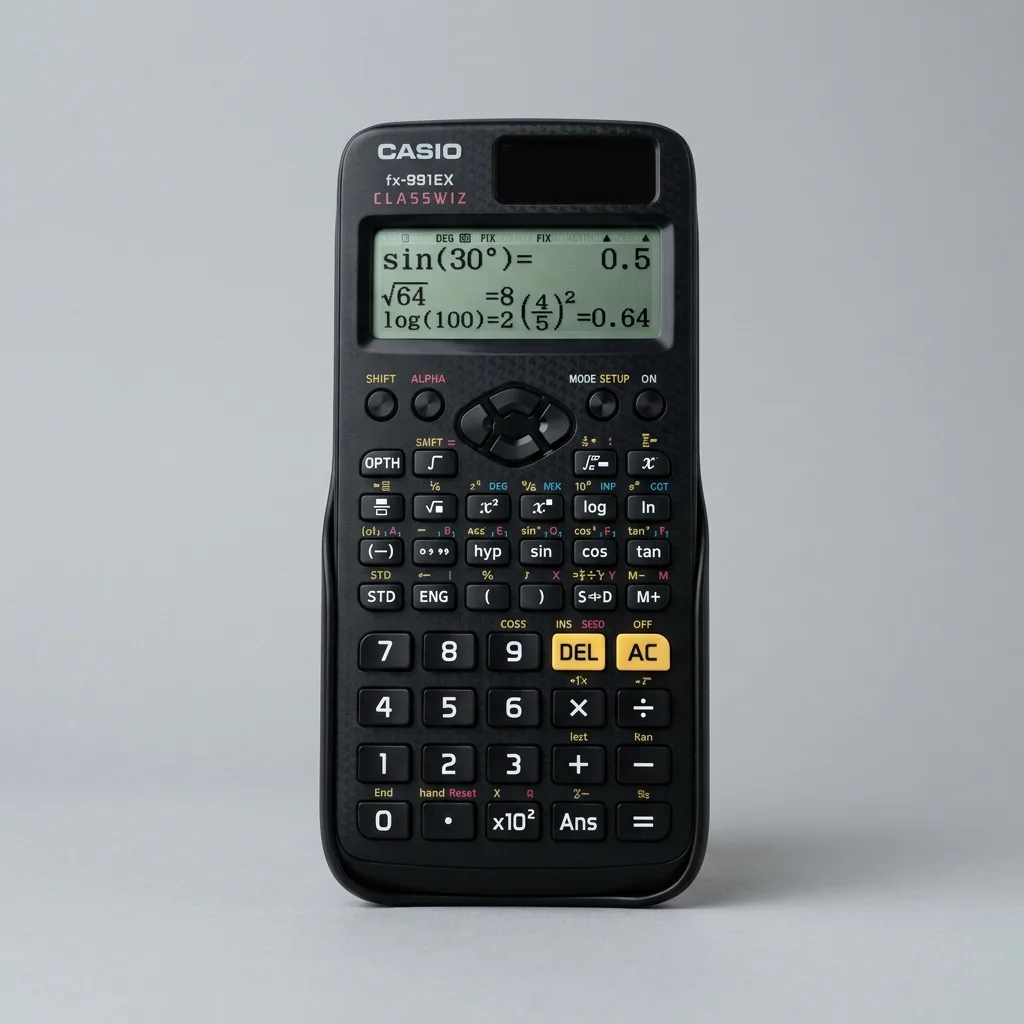
The #1 recommended scientific calculator for board exams, math, and physics.
As an Amazon Associate we earn from qualifying purchases.
Welcome to Class V Mathematics: Can You See the Pattern. This chapter forms a core structural component of the math syllabus, designed to build analytical rigor and key formula models.
Use the detailed subtopic guide below to review standard definitions, key mathematical rules, and study guidelines.
This comprehensive study guide for Can You See the Pattern is designed for Class V students following the CBSE and NCERT Mathematics curriculum. It covers 4 key subtopics including Number series tricks, Magic squares 3x3, Palindrome numbers, and 1 more essential concepts. Whether you are preparing for school examinations, CBSE board exams, or competitive tests, this resource provides everything you need to build a strong conceptual foundation and achieve mastery.
The chapter includes 1 key formulas and equations, 1 fully worked step-by-step example problems, interactive practice exercises across 9 difficulty categories, timed mock quizzes, and downloadable worksheets. Each topic is explained with detailed concept definitions, mathematical representations, and expert study guidelines to help you understand not just the "how" but the "why" behind every formula and method.
Mathematics is a subject that rewards consistent practice and conceptual clarity over rote memorization. As you work through this chapter on Can You See the Pattern, focus on understanding the underlying principles first, then gradually increase problem difficulty. Use the practice sections to identify and strengthen weak areas, and refer to the common mistakes section to avoid the pitfalls that most students encounter.
By the end of studying Can You See the Pattern for Class V, you will have developed proficiency in the following learning outcomes as outlined by the NCERT syllabus:
Analyze and extend number patterns and series.
Construct magic squares where rows, columns, and diagonals sum to the same total.
Identify palindromic patterns.
Before studying Can You See the Pattern, make sure you are comfortable with the following prerequisite concepts. A strong foundation in these areas will help you understand new topics faster and solve problems more confidently:
If any of these prerequisites feel unfamiliar, consider reviewing them first using the Related Chapters section at the bottom of this page. Building a solid base ensures you can tackle Can You See the Pattern with full confidence.
Students often wonder “Where will I use Can You See the Patternin real life?” The answer is: everywhere. The mathematical concepts you learn in this chapter have practical applications across science, engineering, technology, medicine, finance, and everyday problem-solving. Here are some notable examples:
Understanding Can You See the Pattern is essential for scoring well in CBSE board exams, competitive entrance tests like JEE and NEET, and mathematical olympiads.
The concepts in Can You See the Pattern form the foundation for advanced studies in engineering, computer science, physics, economics, and data science at the university level.
Studying Can You See the Pattern develops analytical thinking, pattern recognition, and systematic problem-solving skills that are valuable in every career and daily life situation.
Modern technologies from smartphones to space exploration rely on mathematical principles. Understanding Can You See the Pattern connects you to the math that powers innovation.
Understanding the real-world relevance of Can You See the Pattern not only makes learning more engaging but also helps you appreciate how mathematical thinking is a superpower that opens doors in virtually every career path — from engineering and medicine to finance and technology.
Follow these expert study strategies to maximize your understanding and exam performance in this chapter. These tips are specifically tailored for the type of content covered in Can You See the Pattern:
Draw concept maps connecting definitions, properties, and theorems visually. Abstract chapters have many interconnected ideas, and mind maps help you see the big picture and recall relationships during exams.
For every abstract definition, create a specific numerical example. For instance, when learning about injective functions, write down f(x) = 2x+1 and verify injectivity with actual numbers.
Abstract concepts become memorable when linked to real-world applications. Sets relate to database queries, matrices to image transformations, permutations to password security.
Pro Tip: Consistency beats intensity. Studying Can You See the Pattern for 30 minutes daily is far more effective than cramming for 5 hours before the exam. Use the practice sections below to build muscle memory through regular problem-solving.
Review detailed conceptual explanations, mathematical equations, and guidelines for each subtopic in this chapter:
Identifying arithmetic patterns in a list of numbers to find missing values or predict subsequent terms.
A 3x3 grid of numbers where the sum of numbers in each row, column, and diagonal is the exact same constant.
Palindrome numbers read the same backward as forward (e.g. 121, 3443, 12321).
Sequences of geometric drawings that rotate or reflect in a predictable pattern, maintaining symmetry.
By the end of this chapter, students will be able to master and solve questions on these outcomes:
Analyze and extend number patterns and series.
Construct magic squares where rows, columns, and diagonals sum to the same total.
Identify palindromic patterns.
Sum of a row in a magic square is 3 times the center cell value C.
[From Be My Multiple I'll Be Your Factor] Product of two numbers is equal to product of their LCM and HCF.
[From Mapping Your Way] Converts measured map distance to ground scale.
Solve trigonometric, exponential, logarithmic, and root functions for standard algebraic values.
Deterministic Mathematical Simulation Engine • Client-Side Computation
Solve trigonometric, exponential, logarithmic, and root functions for standard algebraic values.
| Parameter | Value | Unit |
|---|---|---|
| Value (X) | 45 | — |
| Function | sin | — |
| Metric | Calculated Output |
|---|---|
| Function Output | 0.707 |
MATH SOLVER RUNNING:
 [Inputs] ──► [Mathematical Formula] ──► [Outputs]
  Processed elements successfully.
📚 Level up by completing practice sets.
100% Mastery
No weak areas logged!
Simple algebraic checks with hints and solutions enabled.
Standard curriculum queries matching board exam templates.
Complex math application questions with numeric inputs.
5 mixed questions with a ticking clock to evaluate speed.
Specialized assessment matching the printed worksheets.
Strict 10-question chapter exam. Hints are disabled.
Combines prerequisite concepts and related chapter formulas.
Original questions from previous year CBSE board exams.
High-order logical problems matching Olympiad standards.
Test your math skills with this 5-question chapter mock exam. A live ticking clock will monitor your performance.
Review and solve 0 real Board paper questions from the 16 mock sample sets matching Can You See the Pattern.
No questions found in this section for this chapter.
Recognizing and eliminating common errors is a key step to scoring high marks in school and board exams:
Solving additions or subtractions before evaluating parentheses, exponents, divisions or multiplications.
Doing addition/subtraction to only one side of the equation when rearranging terms.
Misplacing the decimal dot when dividing by factors of ten.
Commit core formulas to memory and write them down before solving problems.
Verify that all physical parameters use compatible measurement units.
Use our interactive calculator solvers to verify manually computed decimal answers.
Ensure all prerequisite concepts are fully understood before working on advanced calculations.
Always check equations step-by-step to avoid simple sign and arithmetic errors.
Resolve equations using alternative methods (e.g., check quadratic roots by plugging them back into ax² + bx + c), verify decimals using scientific solvers, and review step-by-step worked calculations.
Trigonometry is used in architecture, mechanics and navigation. Quadratic equations model rocket trajectories and profit boundaries. Basic arithmetic and fractions are applied in accounting, budgeting and lab chemistry.
Check out these related chapters and pre-requisites to strengthen your analytical foundation:
[Adjacent Chapter] Evaluate prime factors of numbers using factor trees.
[Adjacent Chapter] Read city maps and calculate ground distances using scale conversions.
Read and write large integer numbers up to 8 digits.
Use these related calculator solvers to verify variables and double check homework steps:
Solve trigonometric, exponential, logarithmic, and root functions for standard algebraic values.
Perform arithmetic operations on fractions: add, subtract, multiply, and divide two fractions. Simplifies the results dynamically and provides decimal equivalencies.
Select any key syllabus topic below to open its detailed learning guide, worked models, and study guidelines.
Learn the easiest ways to simplify fractions. Master finding the Greatest Common Divisor (GCD) and reducing fractions to their simplest form with worked examples.
Demystify mathematical sequences. Learn to identify arithmetic and geometric progressions, calculate common differences/ratios, and find the nth term.
Learn the math behind ratios and proportions. Master scaling values, dividing amounts by ratios, and solving proportions using cross-multiplication.
Generate and print a beautiful chapter worksheet complete with key equations, problems, and dedicated writing spaces.
1. [Worksheet Question 1] Apply the formula Magic Constant (3x3) to solve for coefficient constants. What is the value?
2. [Worksheet Question 2] Apply the formula Magic Constant (3x3) to solve for coefficient constants. What is the value?
3. [Worksheet Question 3] Apply the formula Magic Constant (3x3) to solve for coefficient constants. What is the value?
4. [Worksheet Question 4] Apply the formula Magic Constant (3x3) to solve for coefficient constants. What is the value?
5. [Worksheet Question 5] Apply the formula Magic Constant (3x3) to solve for coefficient constants. What is the value?