The Central Provident Fund (CPF) is the cornerstone of Singapore's social security and retirement savings framework. Every working Singapore Citizen and Permanent Resident contributes a portion of their monthly income to CPF, matched by an employer contribution. As we enter 2026, major regulatory adjustments � including the final phase of the Ordinary Wage (OW) ceiling increase � directly impact monthly take-home pay and retirement allocations.
The S$8,000 Ordinary Wage (OW) Ceiling Increase in 2026
To keep pace with rising salaries, the Singapore government progressively raised the monthly Ordinary Wage (OW) ceiling from S6,000 to S8,000. Effective 1 January 2026, the ceiling reaches its final targeted cap of **S8,000 per month**. This means CPF contributions are calculated on gross wages up to S8,000; any earnings above this threshold are exempt from statutory CPF contributions.
CPF Monthly Cap Example:
If you earn S10,000 a month, only the first S8,000 is subject to CPF. Your remaining S$2,000 is paid fully as cash take-home pay with no CPF deductions.
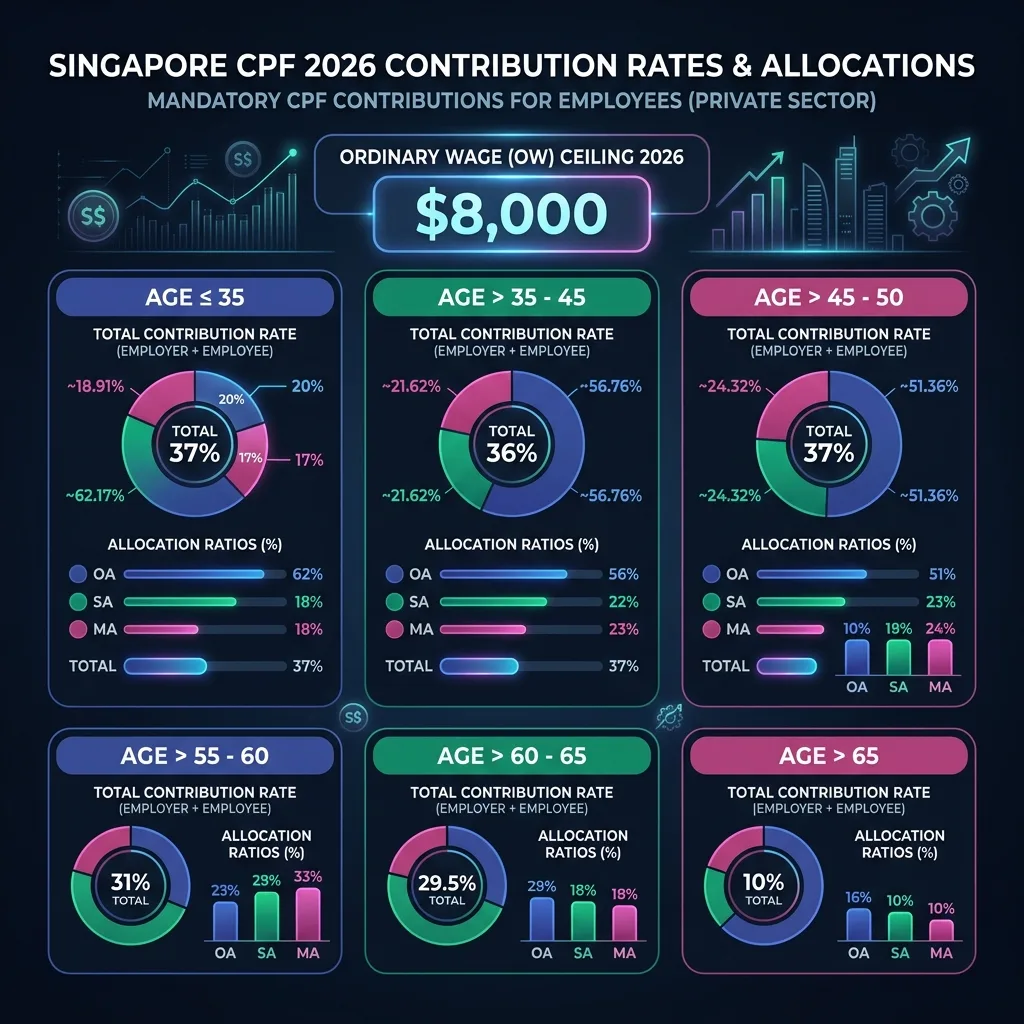
CPF Contribution Rates by Age Group (2026)
For Singapore Citizens and 3rd year+ Permanent Residents, the total CPF contribution rate is 37% of wages for employees aged 55 and below. However, as workers age, contribution rates step down to balance retirement security with employability:
- Age 55 & Below: Employee contributes 20%, Employer contributes 17% (Total: 37%)
- Age 56 to 60: Employee contributes 16%, Employer contributes 18% (Total: 34%)
- Age 61 to 65: Employee contributes 12.5%, Employer contributes 12.5% (Total: 25%)
- Age 66 to 70: Employee contributes 7.5%, Employer contributes 9% (Total: 16.5%)
- Age 71 & Above: Employee contributes 5%, Employer contributes 7.5% (Total: 12.5%)
Where Does the Money Go? OA, SA/RA, and MA allocations
Your total monthly CPF contributions are allocated across three separate interest-bearing accounts. The allocation ratio is dynamic and shifts as you age, prioritizing housing in your early career and transitioning to retirement and healthcare in later years:
- Ordinary Account (OA): Primarily used for housing downpayments, home loan installments, and approved education or investment. Earns a baseline interest rate of 2.5% per annum.
- Special Account (SA): Dedicated to retirement savings, earning a higher interest rate of 4% per annum. Note: At age 55, the Special Account is closed and funds are transferred to the Retirement Account (RA).
- MediSave Account (MA): Reserved for medical expenses, health insurance (e.g. MediShield Life), and approved outpatient treatments. Earns 4% per annum.
Strategic Tips to Maximize Your CPF Growth
- OA-to-SA Transfer: If you do not plan to buy property soon, you can transfer funds from OA to SA to boost your interest rate from 2.5% to 4%. This is a one-way transfer that cannot be reversed.
- Retirement Sum Topping-Up (RSTU) Scheme: Top up your Special Account (if under 55) or Retirement Account (if 55+) with cash. You can get tax relief of up to S
8,000 per year for personal top-ups, and another S8,000 for topping up loved ones' accounts. - CPF Investment Scheme (CPFIS): If you are a confident investor, you can invest OA funds exceeding S
20,000 and SA funds exceeding S40,000 in approved shares, gold, and mutual funds.
Want to see exactly how your salary is split between take-home pay and your CPF accounts? Scroll down to the interactive Singapore CPF Calculator below to key in your salary and age, and see a full monthly and annual breakdown instantly!